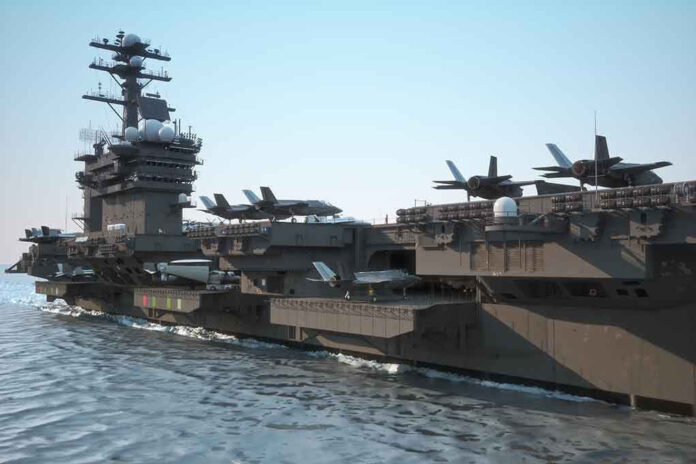
China has achieved a technological milestone that directly challenges American naval supremacy, commissioning its third aircraft carrier with electromagnetic catapult systems that rival our most advanced warships.
Story Highlights
- China’s Fujian carrier features electromagnetic catapults previously exclusive to U.S. Navy technology
- Beijing skipped steam catapult development, leapfrogging directly to advanced launch systems
- Xi Jinping personally attended commissioning ceremony, signaling strategic military priorities
- Experts warn of operational readiness gaps despite impressive technological demonstrations
Strategic Naval Competition Intensifies
The People’s Liberation Army Navy commissioned the Fujian on November 5, 2025, marking a pivotal moment in China’s naval modernization campaign. This Type 003 Class carrier represents the first non-American vessel equipped with electromagnetic aircraft launch systems, technology previously unique to the U.S. Navy’s Gerald R. Ford-class carriers. Xi Jinping’s personal attendance at the Sanya commissioning ceremony underscores the political significance Beijing places on challenging American naval dominance in the Indo-Pacific region.
China’s navy flexes muscles with new flattops https://t.co/aNn3UOWxkZ
— Task & Purpose (@TaskandPurpose) December 2, 2025
China’s rapid progression from Soviet-era designs to cutting-edge catapult technology demonstrates an accelerated development timeline that bypassed traditional evolutionary steps. The Fujian features three electromagnetic catapults compared to four on American supercarriers, launching advanced aircraft including J-35 stealth fighters, J-15T fighters, and KJ-600 early warning aircraft. This technological leap represents a direct challenge to American military superiority that patriots should monitor closely.
Operational Reality Check
Despite impressive technological achievements, defense experts identify critical gaps between Chinese capabilities and American operational experience. Bryan Clark, a retired U.S. Navy submarine officer at the Hudson Institute, emphasized that “You can engineer and build something much quicker than you can build up a group of people to operate it.” The September 2025 catapult demonstrations occurred under controlled sea trial conditions, not reflecting combat stress or adverse weather scenarios that test true operational readiness.
American carriers typically support 60-70 aircraft compared to China’s current air wing capacity, while decades of operational experience provide the U.S. Navy substantial advantages in crew training, doctrine development, and institutional knowledge. However, China’s demonstrated ability to rapidly advance technologically suggests sustained momentum in narrowing capability gaps. The communist regime’s shipbuilding sector notably dwarfs American industrial capacity, enabling parallel development of supporting vessels and infrastructure.
Growing Threat Assessment
China’s expanded three-carrier fleet immediately enhances regional power projection capabilities throughout the Indo-Pacific, particularly concerning Taiwan contingencies and First Island Chain operations. Satellite imagery indicates construction of a Type 004 nuclear-powered carrier at Jiangnan shipyard, potentially providing unlimited operational range capabilities. This industrial momentum reflects Beijing’s comprehensive naval strategy extending far beyond individual vessels to challenge American maritime dominance.
The strategic implications demand serious attention from American defense planners and patriots concerned about maintaining military superiority. China’s achievement of launching stealth aircraft via electromagnetic catapults before the U.S. Navy fully certifies F-35C operations represents a symbolic milestone that undermines perceptions of American technological leadership. While operational reliability remains unproven at scale, the trajectory clearly threatens long-term American naval advantages that have secured global stability for decades.
Sources:
How China’s aircraft carriers are stacking up to the US Navy
China’s navy flexes muscles with new flattops
Chinese aircraft carrier Fujian
China Commissions Newest Aircraft Carrier With Its Electromagnetic Catapults Front and Center