
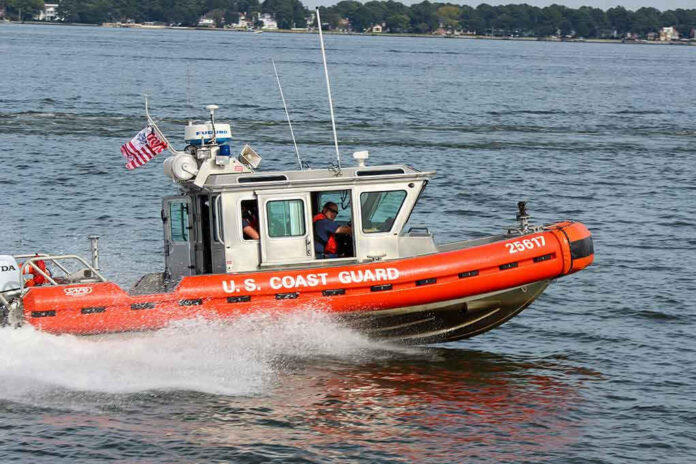
Two hundred and forty people crammed onto a 45-foot wooden boat taking on water is not a political talking point — it is a maritime emergency, and the U.S. Coast Guard just proved the system can still work when agencies actually coordinate.
Story Snapshot
- A joint operation involving the U.S. Coast Guard, Customs and Border Protection (CBP) Air and Marine Operations, and Turks and Caicos authorities intercepted an overcrowded vessel carrying 240 migrants near the Turks and Caicos Islands on May 31, 2026.
- The boat, a 45-foot wooden vessel, was overloaded and actively taking on water when authorities reached it, making the interception simultaneously a rescue and an enforcement action.
- Royal Turks and Caicos Islands Police tracked the vessel before the U.S. Coast Guard intercepted it, demonstrating the kind of multi-nation coordination that rarely makes headlines when it succeeds.
- All individuals aboard were transferred to Turks and Caicos Border Force for processing, consistent with how the Coast Guard handles maritime interdictions far from U.S. shores.
A Wooden Boat, 240 People, and a Race Against the Clock
Customs and Border Protection Air Interdiction Agents spotted the vessel first, triggering a response chain that moved fast. The Royal Turks and Caicos Islands Police Force launched marine and regiment vessels to track it, and the U.S. Coast Guard executed the interception. [2] What surveillance footage showed was a 45-foot wooden hull riding dangerously low in the water with people packed so tightly there was no visible deck space. At that displacement and in open Caribbean waters, the margin between a rescue and a mass-casualty event was measured in minutes, not hours.
The Turks and Caicos Islands Regiment described its role as a “tactical interception” followed by the “immediate stabilization of the vessel,” language that signals the boat required active intervention just to stay afloat. [5] CBS12 reporting confirmed the vessel was both overloaded and taking on water. [1] That combination, an undersized hull, maximum human weight load, and active flooding, is the exact scenario maritime safety professionals identify as the highest-probability mass drowning event in irregular migration. The agencies involved did not have the luxury of waiting for paperwork.
How Multi-Agency Maritime Coordination Actually Works
The Defense Visual Information Distribution Service (DVIDS) video documenting the operation names three distinct entities working in concert: the U.S. Coast Guard, CBP Air and Marine Operations, and Turks and Caicos partner agencies. [6] That is not a bureaucratic formality. Maritime interdiction near a foreign island chain requires aerial detection, surface pursuit, and host-nation legal authority to board and tow. Remove any one of those three elements and the operation either fails legally or fails physically. The May 31 interception worked because all three showed up.
The Royal Turks and Caicos Islands Police Force towed the vessel to South Dock Marina after the interception, and the Turks and Caicos Border Force assumed custody for processing. [2] This transfer of custody is standard operating procedure and reflects a deliberate legal architecture: the Coast Guard interdicts in international or partner-nation waters, and the host nation handles the onshore disposition. Critics who frame this as the United States washing its hands of a humanitarian situation misread how bilateral maritime enforcement agreements are designed to function.
The Turks and Caicos Route Is Not a New Discovery
This was not a one-off incident. The waters around Turks and Caicos have become a documented transit corridor for irregular migration, with multiple interceptions logged in recent years. A Coast Guard cutter intercepted a vessel 60 miles south of the islands in September 2024, and the Coast Guard subsequently repatriated 182 migrants to Haiti from that operation. [4] Newsline TCI has separately reported on a vessel carrying 103 migrants taken from the same general corridor. [7] The geography explains the pattern: Turks and Caicos sits roughly 575 miles southeast of Miami, close enough to represent a plausible staging point for anyone attempting to reach Florida by sea.
US Coast Guard intercepts vessel with 240 migrants near Turks and Caicos Islands https://t.co/zwUaaSjEfL
— MixVale (@Mixvale) June 5, 2026
Smuggling networks exploit that geography deliberately. They overload vessels to maximize per-trip revenue, knowing that even a catastrophic sinking generates only intermittent enforcement pressure. The 240-person load on a 45-foot hull is not a logistical miscalculation — it is a business model that treats human lives as cargo weight. The agencies that stopped this particular boat did not just enforce immigration law; they interrupted a profit calculation that would have continued regardless of outcome for the people aboard.
What the Record Confirms and What It Does Not
The documented facts are solid on the core claim: 240 people, one dangerously overloaded vessel, a coordinated multi-agency interception, and a transfer to Turks and Caicos custody. [6][2][1] What the current public record does not resolve is destination intent. The available sources do not include passenger statements, route intelligence, or destination declarations proving the vessel was headed for the United States specifically. That evidentiary gap matters for legal classification, but it changes nothing about the physical reality of 240 people on a sinking boat. The humanitarian case for interception does not require proving U.S. entry intent. The safety case made itself.
Sources:
[1] Web – Coast Guard Stops 240 Illegal Immigrants on Overcrowded Vessel
[2] Web – Overcrowded boat carrying 240 Haitian migrants interdicted near …
[4] Web – Coast Guard helps intercept overloaded vessel carrying 240 migrants
[5] Web – Coast Guard repatriates 182 migrants to Haiti
[6] Web – TURKS AND CAICOS ISLANDS REGIMENT INTERCEPTS VESSEL …
[7] Web – Coast Guard, CBP, partner agencies interdict 240 aliens near Turks …
© conservativehub.com 2026. All rights reserved.