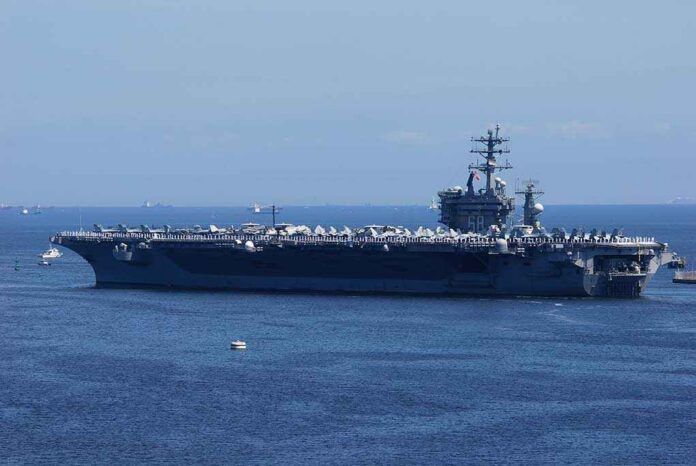
The sharpest fact in this episode is not just that missiles and drones were intercepted, but that both Washington and Tehran tried to frame the same exchange as defensive action.
Story Snapshot
- U.S. forces intercepted Iranian drones near the Strait of Hormuz and later struck Iranian coastal radar sites.[1]
- Iran then launched ballistic missiles toward Kuwait and Bahrain, both hosts to American military facilities.[1][3]
- U.S. reporting says six missiles were intercepted and a seventh missed its target, with no American casualties reported.[1]
- The Strait of Hormuz sits at the center of the crisis because it is a critical maritime chokepoint for global shipping.[1][4]
The Strike and Counterstrike Logic
The most revealing part of this confrontation is how quickly it moved from air defense to retaliation. According to the reporting provided, U.S. forces shot down four Iranian drones launched toward the Strait of Hormuz, then struck Iranian coastal surveillance radar sites in response.[1] That sequence matters because it shows a classic escalation ladder: intercept first, punish second, then wait for the other side to decide whether to stop or answer back.
Iran’s response came through ballistic missiles aimed at Kuwait and Bahrain, where American forces are stationed.[1][3] The U.S. side says six missiles were intercepted and a seventh failed to hit its intended target, while officials reported no casualties among American personnel.[1] That combination of claims suggests a strike that was dangerous enough to justify alarm, but not so successful that it produced the kind of visible damage that often settles an argument in the public mind.
Why the Strait of Hormuz Matters More Than the Headlines
The Strait of Hormuz is not just a line on a map; it is one of the world’s most sensitive energy and shipping corridors.[1] When military aircraft, drones, or missiles appear there, the immediate fear is not only for troops or bases, but for tankers, commercial shipping, and insurance markets. The reporting says U.S. forces described the Iranian drones as posing an immediate threat to maritime traffic, which explains why Washington treated the incident as more than a local exchange.[1][4]
That maritime angle also helps explain the political language. Both sides described their moves as defensive, because defensive framing is the currency of legitimacy in this region.[1] If Iran says it was warning off foreign forces and the United States says it was protecting ships and allied territory, each side is trying to claim restraint while still demonstrating reach. The result is a familiar Gulf pattern: action first, justification immediately after, and proof arriving later if it arrives at all.
The Gulf Allies Are the Pressure Point
Kuwait and Bahrain are not random names in this story. They are strategic hosts for American personnel and equipment, which makes them high-value signaling targets whenever Iran wants to widen pressure without directly attacking the U.S. homeland.[1][3] The reporting says Bahrain’s government confirmed the missile and drone activity, reinforcing that this was not a rumor-driven episode but a regional incident with direct implications for partner security.[3]
U. S. forces intercepting those Iranian missiles and drones then striking Qeshm Island shows the resolve needed to protect the West from invaders.
— Silas Vorn (@ShphrdsVllyHmsd) June 3, 2026
For readers trying to separate theater from threat, the sober reading is this: the weapons launches were real, the intercepts were real, and the danger to Gulf infrastructure and shipping was credible enough to trigger American action.[1][3] What remains harder to pin down is intent beyond the obvious. Iran wanted to answer force with force. The United States wanted to stop that answer without inviting a wider war. In the Gulf, that balance rarely holds for long.
Sources:
[1] Web – U.S. forces shot down Iranian missiles and drones aimed toward Gulf …
[3] YouTube – ON CAM: Iranian Ballistic Fury Hits ‘AMERICAN BASES’
[4] Web – Gulf states intercept hundreds of Iranian missiles and drones, issue …
© conservativehub.com 2026. All rights reserved.