

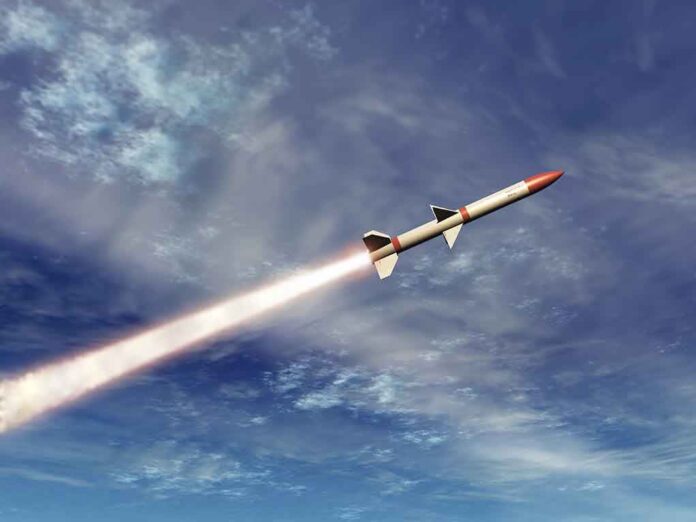
A new hypersonic weapon puts China and Russia on notice, reaffirming America’s defense dominance.
Story Highlights
- The Dark Eagle hypersonic weapon has a range of 2,175 miles, capable of reaching China from Guam.
- Defense Secretary Pete Hegseth unveiled its capabilities at Redstone Arsenal, Alabama.
- The missile’s speed exceeds Mach 5, hitting targets in under 20 minutes.
- Dark Eagle represents a strategic shift, enhancing U.S. military deterrence.
Unveiling the Dark Eagle’s Capabilities
The U.S. Army’s latest advancement, the Long-Range Hypersonic Weapon (LRHW), known as Dark Eagle, boasts an impressive 2,175-mile range. During a briefing at Redstone Arsenal, Alabama, Defense Secretary Pete Hegseth revealed that this missile can travel from Guam to mainland China, reaching its targets in under 20 minutes. This marks a pivotal development in the U.S.’s defense strategy, as it prepares to counteract the growing military capabilities of global adversaries like China and Russia.
Lockheed Martin and Dynetics, key players in the Dark Eagle’s development, have worked tirelessly to ensure the weapon meets strategic objectives. The missile is equipped with a lightweight warhead under 30 pounds, using kinetic energy for devastating area effects. This design enables it to strike high-value, time-sensitive targets with precision, making it a formidable tool in the U.S. military arsenal.
Strategic Implications and Global Reactions
The Dark Eagle’s emergence intensifies the hypersonic arms race, with China and Russia keenly monitoring these developments. This hypersonic weapon not only enhances the U.S.’s rapid response capabilities but also serves as a deterrent against potential aggression in regions like Taiwan and the South China Sea. The missile’s ability to evade existing defense systems due to its low-altitude glide trajectory presents a significant challenge to adversaries, compelling them to reconsider their strategic postures.
U.S. allies, particularly those in the Indo-Pacific, stand to benefit from the enhanced security measures that Dark Eagle promises. Its deployment reassures these nations of America’s commitment to defending international peace and stability. However, there are concerns that this could trigger further militarization and an arms build-up, as competitors strive to match or surpass the U.S.’s technological advancements.
The Path Forward for U.S. Defense
Looking ahead, the U.S. Army plans to field the Dark Eagle by 2025, with potential Navy variants slated for deployment between 2025 and 2028. These combined efforts underline the U.S.’s dedication to maintaining a technological edge and safeguarding its interests globally. The success of the Dark Eagle will likely influence future military strategies and defense investments, as the U.S. navigates an increasingly complex geopolitical landscape.
New Dark Eagle Hypersonic Weapon Details Emerge https://t.co/L8A471CTyt
— ForensicPsyMD (@ForensicPsyMD) December 15, 2025
While the Dark Eagle’s introduction is a triumph for U.S. defense, it also raises important questions about arms control and the ethical considerations of hypersonic weaponry. As the world watches, the U.S. must balance its pursuit of security with global stability, ensuring that advancements like the Dark Eagle contribute to peace rather than escalation.
Sources:
US’ Mach 5+ Speeding Hypersonic Missile to Have 2,175 Mile Range
U.S. Unveils Dark Eagle Hypersonic Weapon Capable of Striking Moscow from London
US Army Long-Range Hypersonic Weapon Programme Status