

Russia has unleashed a systematic campaign of sabotage across Europe that puts civilian lives at risk and threatens the continent’s critical infrastructure.
Story Snapshot
- Associated Press documented 145 cases of Russian-linked sabotage and disruption operations
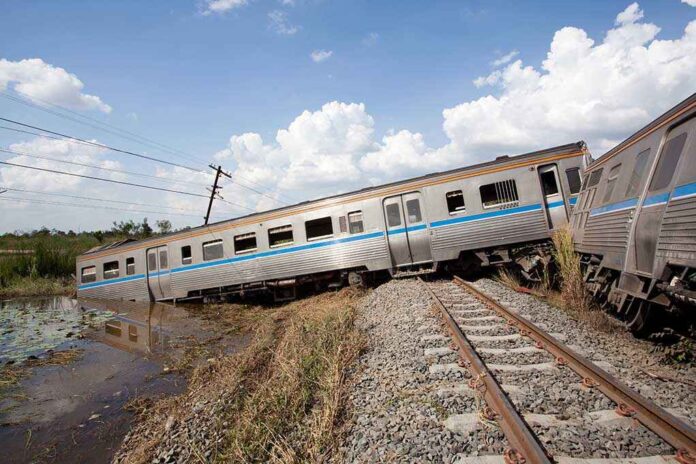
- A passenger train with nearly 500 people was attacked in eastern Poland using explosives and infrastructure damage
- Russia targets civilian transportation networks, putting innocent lives in immediate danger
- These attacks represent a coordinated effort to destabilize European nations through terror tactics
Russia’s Shadow War Escalates to Civilian Targets
The Associated Press investigation reveals the alarming scope of Russia’s covert operations against European infrastructure. Officials have documented 145 separate incidents of sabotage and disruption activities directly attributed to Russian operatives. These attacks mark a dangerous escalation from traditional espionage to direct threats against civilian populations, demonstrating Putin’s willingness to terrorize ordinary Europeans to achieve his geopolitical objectives.
The targeting of civilian infrastructure represents a clear violation of international law and basic human decency. Russia’s operatives deliberately chose tactics that could result in mass casualties, showing complete disregard for innocent lives. This systematic approach suggests coordination at the highest levels of the Russian government, making these acts of state-sponsored terrorism rather than isolated incidents.
Poland Train Attack Exposes Vulnerability of Transportation Networks
The November incident in eastern Poland illustrates the deadly precision of Russia’s sabotage campaign. Russian operatives coordinated a multi-pronged attack that damaged overhead electrical lines, shattered train windows, and detonated explosives under a separate freight train. The timing and execution required detailed planning and surveillance, indicating sophisticated operational capabilities that extend far beyond simple vandalism.
Nearly 500 passengers found themselves trapped in a disabled train, completely vulnerable to further attack. The broken windows and damaged track created immediate safety hazards that could have resulted in derailment or electrocution. Russian operatives demonstrated they possess both the capability and willingness to execute complex operations that put hundreds of civilians at risk simultaneously.
Strategic Implications of Infrastructure Warfare
Russia’s choice to target transportation networks reveals a calculated strategy to undermine European unity and economic stability. Railway systems form the backbone of European commerce and civilian mobility, making them high-value targets for maximum disruption. By attacking these networks, Russia seeks to create fear among ordinary citizens while imposing economic costs on target nations.
The geographic spread of these 145 documented incidents suggests Russia has established extensive operational networks throughout Europe. This capability represents years of preparation and infiltration, indicating that current attacks may represent only the beginning of a larger campaign. European intelligence services now face the challenge of identifying and neutralizing sleeper cells that may have been positioned years in advance.
European Security Response Proves Inadequate
The success of these sabotage operations exposes critical vulnerabilities in European security protocols. Despite increased tensions following Russia’s invasion of Ukraine, European nations failed to adequately protect their infrastructure from relatively simple attacks. The ability of Russian operatives to place explosives on active railway lines demonstrates gaps in surveillance and security that require immediate attention.
European leaders must acknowledge that they are already at war with Russia, even if they refuse to admit it publicly. The 145 documented cases represent acts of war against civilian populations, demanding a proportional response that goes beyond diplomatic protests. Continued weakness in the face of these attacks only encourages Putin to escalate further, potentially leading to mass casualty events that could have been prevented through decisive action.
Sources: