
conservativehub.com — Mandatory Ebola screenings at Atlanta’s airport are not just about thermometers and questionnaires; they are a live stress test of how far government power should reach when fear collides with freedom and common sense.
Story Snapshot
- Mandatory Ebola screening and 21-day monitoring now target travelers routed through Atlanta from three African nations.
- Federal health agencies call this part of a “layered” defense, not a silver bullet.
- Critics question whether expanding to more airports adds safety or just more federal hassle.
- The policy revives a core question: what does smart border security look like in a real health scare?
Atlanta’s new role as a mandatory Ebola checkpoint
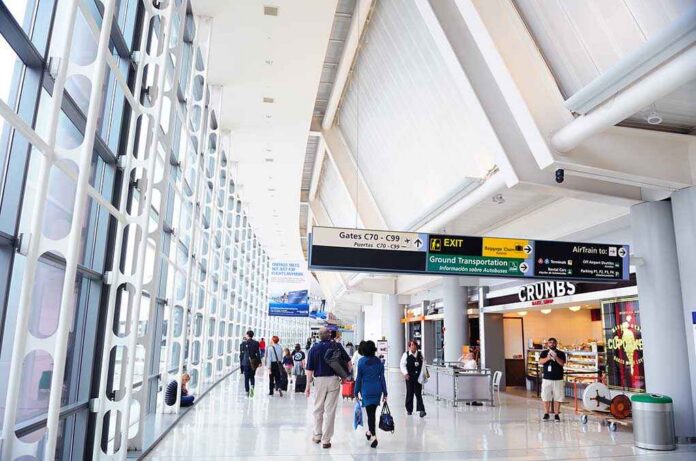
Hartsfield-Jackson Atlanta International Airport quietly shifted from travel hub to triage point when the Centers for Disease Control and Prevention (CDC) expanded mandatory Ebola screening there just before midnight on May 22, 2026.[2][1] Travelers who have been in the Democratic Republic of the Congo, Uganda, or South Sudan within the prior 21 days can no longer drift into the country through any airport they choose; they are funneled into a short list of designated gateways, now including Atlanta.[1][4] The government has not said when these restrictions will end.[1]
Washington Dulles International Airport was the first choke point, with enhanced screening starting there on May 20, and Atlanta became the second.[2][4] A Department of Homeland Security order initially routed all relevant flights only to Dulles, then broadened to allow certain international flights to land at Atlanta once the CDC confirmed that Hartsfield-Jackson had prior experience and “established operational procedures” for Ebola screening.[2][4] A third site in Houston is scheduled to join this network, turning a single bottleneck into a small corridor of controlled entry.[1][4]
What “layered public health” actually means at the border
The CDC does not pretend that a temperature check at Atlanta magically keeps Ebola out.[2] Instead, the agency describes enhanced entry screening as one layer in a stack: overseas exit checks before travelers board, airline illness reporting while they are in the air, on-arrival screening at specific airports, and then public health monitoring after they are in the country.[2] That layered framing matters because it acknowledges a basic reality: most infected travelers will not be glowing red on a thermal scanner, and no single checkpoint will catch everything.
From a conservative, common-sense lens, this layered approach looks a lot like classic border security logic. You do not rely on one fence or one patrol; you build multiple hurdles so that a small number of high-risk cases are more likely to be noticed somewhere in the system. Routing all travelers from the outbreak region through a few known airports gives authorities a defined population to track, rather than scattering responsibility across dozens of unprepared terminals.[1][4] The question is not whether layering is rational—it is whether every additional layer truly adds value, or just theater and bureaucracy.
The skepticism: burden, benefit, and the missing math
The public record offers plenty of detail on what Atlanta will do, but almost nothing on how much extra safety it buys over leaving all screening at Dulles.[2][4] The CDC statement talks about layered protection, yet provides no risk model, no estimate of additional cases caught, and no analysis of false negatives or resource costs tied specifically to expanding into Atlanta.[2] That absence does not prove the move is useless, but it leaves citizens evaluating a serious intrusion—rerouted flights, mandatory checks, and 21-day monitoring—without hard numbers to weigh benefit against burden.
Federal agencies also have not reported any Ebola cases linked to travelers routed through Atlanta under the new regime.[4] That could mean the system is working as a deterrent or early-warning tool. It could also mean the risk of importation is extremely low and the visible hassle mainly reassures nervous voters. For many skeptical Americans, especially after years of shifting rules during the coronavirus era, a “trust us” posture without transparent data feels less like prudence and more like an invitation to mission creep.
Visibility, fear, and the politics of health security
Airport screening tends to become the political front line in every big outbreak because it is visible, dramatic, and easy to point to in a press conference.[2][1] A traveler standing in front of a thermal camera sends a strong message that someone is in charge, even if the real heavy lifting happens later in county health offices and hospital isolation units. Designating Atlanta, the nation’s busiest hub, as an Ebola checkpoint amplifies that visual signal nationwide: the federal government is watching the borders, and you will see it when you fly.
"Mandatory Ebola screenings have officially expanded to Hartsfield-Jackson Atlanta International Airport for travelers arriving from the DRC, Uganda, and South Sudan. 🚨
Those who pass will still face 21 days of strict symptom monitoring by local health departments.
— Mazi okwuoma (@MaziEzike_Nedu) May 26, 2026
That visibility cuts both ways. On one hand, it aligns with conservative priorities of strong borders and targeted control of high-risk flows, rather than blanket domestic restrictions. On the other, it raises the classic limited-government concern: once officials normalize health-based routing rules and mandatory monitoring for a small group, what stops those tools from drifting into broader use in future crises? No one disputes that Ebola is deadly; the deeper contest is over how much unchecked discretion public health agencies should wield in the name of safety.
Sources:
[1] Web – Ebola-related travel restrictions now include Atlanta’s Hartsfield …
[2] Web – Enhanced Ebola Airport Screening Expands to Atlanta – CDC
[4] Web – Public Health Arrival Restrictions and Enhanced Ebola Screening
© conservativehub.com 2026. All rights reserved.