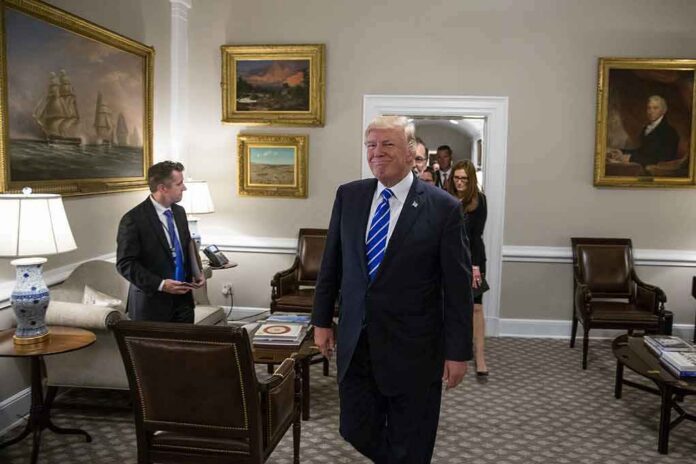
President Trump’s investment accounts bought 327 stocks on April 8, 2025, the day before he announced a 90-day tariff pause that sent markets surging.
Story Snapshot
- Trump’s accounts made 327 stock purchases on April 8, 2025, one day before his tariff pause announcement, according to a financial disclosure filed with the Office of Government Ethics.
- The trades were not reported on time. Trump paid late filing fees, and the trades only came to light through his annual disclosure filed in July 2026.
- Stocks purchased included Apple, Microsoft, Nvidia, Amazon, and Alphabet, with some individual transactions valued up to $250,000.
- The Trump Organization says an independent third-party firm made all trades automatically, with no input from Trump or his family.
- No sitting U.S. president has ever traded individual stocks at this volume before, and no official has ever been prosecuted under the Stop Trading on Congressional Knowledge Act for insider trading.
What the Disclosure Actually Shows
Trump’s annual financial disclosure, filed with the Office of Government Ethics in July 2026, revealed 327 stock purchases made on April 8, 2025. That was the day before Trump announced a 90-day pause on many of his sweeping tariffs. Markets jumped sharply after that announcement. The trades had not been reported within the required 45-day window set by federal ethics law, and an Office of Government Ethics reviewer noted that Trump paid late filing fees to cover the missed deadline.
The scale goes well beyond those 327 trades. Trump’s accounts made more than 3,600 trades across over 1,000 companies in just the first three months of 2025. Financial Times analysis cited by Newsweek found his accounts averaged roughly 60 trades per day across eight investment accounts throughout the year. That pace dwarfs any prior president and any member of Congress, including Nancy Pelosi, who averaged about one trade every 22 days over 12 years.
The Insider Trading Question Has a Big Evidentiary Gap
The timing looks bad. Buying hundreds of major tech stocks the day before a market-moving policy announcement is the kind of pattern that would draw a Securities and Exchange Commission inquiry for any private citizen. Democratic senators and representatives, including Senator Adam Schiff and Representative Mike Levin, have called for a full investigation and cited potential violations of federal ethics and insider trading laws. The optics are impossible to ignore, and the late filing only adds to the suspicion.
But optics are not evidence. The Trump Organization told PBS News Hour that Trump, his family, and the organization play zero role in selecting trades, receive no advance notice, and cannot override the strategies used by the independent third-party firms that manage the accounts. Those firms use automated direct indexing, a strategy that buys and sells large baskets of stocks to mirror an index while harvesting tax losses. Financial experts told Fortune that a 927-page disclosure full of hundreds of daily trades is completely routine for this kind of portfolio management. The sheer volume of trades, over 21,000 in 2025 alone, actually supports the automated explanation more than it supports a targeted insider trade.
The Blind Trust Problem Nobody Wants to Talk About
Here is the real issue that the insider trading debate keeps dancing around. Every modern president before Trump placed assets into a blind trust. A blind trust physically prevents a president from knowing what he owns, which eliminates any conflict of interest. Trump chose not to do that. His assets sit in accounts managed by third parties, but he can still see every holding on his Form 278 disclosure. Former ethics official Richard Painter put it plainly: it makes no difference who executes the trades if the president knows what is in the account.
Trump discloses 327 unreported stock trades made a day before his first tariff pause
Source: NBC Newshttps://t.co/38XpbZetqI— Myrna Laboy (@laboy_myrn35302) July 3, 2026
That structural choice is the core problem, and it is entirely legal. The Stop Trading on Congressional Knowledge (STOCK Act) of 2012 requires disclosure of trades but does not force a president into a blind trust. Remarkably, no member of Congress has ever been prosecuted under the STOCK Act despite thousands of reported trades and numerous alleged violations from both parties. The law has teeth on paper and almost none in practice. Congresswoman Andrea Salinas introduced legislation called the No Profit Act to impose a 100 percent capital gains tax on profits tied to insider trading unless assets are in a blind trust, but it has not passed.
What Should Actually Concern Every American
The insider trading framing, while politically potent, may be the wrong lens. Proving insider trading requires showing that Trump personally directed trades using nonpublic information. No evidence of that exists right now. What does exist is a sitting president running eight investment accounts that trade individual stocks in companies that do direct business with the federal government, at a pace never seen before in the Oval Office. Whether automated or not, that creates a conflict of interest that a blind trust would have prevented entirely. The late filing and the convenient timing make a bad situation look worse than it may actually be, but the underlying structural problem is real regardless of intent.
Sources:
feedpress.me, nbcnews.com, facebook.com, youtube.com, reddit.com, campaignlegal.org
© conservativehub.com 2026. All rights reserved.