A single “quiet” torpedo strike in the Indian Ocean just turned the U.S.-Iran showdown into a real-world test of American resolve—and the facts matter as much as the footage.
Quick Take
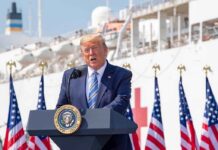
- Pete Hegseth said a U.S. Navy submarine torpedoed and sank Iran’s frigate IRIS Dena near Sri Lanka, with Pentagon-released video circulating online.
- Sri Lankan authorities reported at least 80 dead and 32 rescued after the ship sent a distress call early Wednesday local time.
- The strike reportedly occurred in international waters near Sri Lanka’s exclusive economic zone, pulling a neutral country into a high-stakes regional crisis.
- Hegseth’s claim that it was the first torpedo sinking of an “enemy ship” since World War II was disputed broadly, though a top U.S. commander framed it as U.S.-specific since 1945.
What happened off Sri Lanka—and what’s confirmed so far
U.S. Defense Secretary Pete Hegseth publicly confirmed that an American submarine sank the Iranian warship IRIS Dena with a torpedo strike in the Indian Ocean near Sri Lanka. Sri Lankan officials said the Iranian vessel issued a distress call around 5:08 a.m. Wednesday local time reporting an explosion, and rescue assets located the ship roughly 44 nautical miles off Galle. Reports cited at least 80 deaths and 32 rescues, with recovery operations continuing.
Multiple outlets described Pentagon-released footage showing the impact on the ship, with some accounts saying the damage appeared midship and could involve more than one hit. Independent verification of the full context and authenticity of the circulated clips has been limited in public reporting, and the U.S. Navy has not publicly identified the submarine involved. What is consistent across reports is the basic sequence: explosion, distress call, Sri Lankan response, and a U.S. confirmation.
The “first since WWII” claim, and why precision matters in wartime
Hegseth described the event as the first enemy ship sunk by torpedo since World War II, a line that grabbed headlines and supercharged social media. A fact-check noted that torpedoes have sunk warships after WWII in other conflicts, including the 1971 sinking of India’s INS Khukri by a Pakistani submarine and the 1982 sinking of Argentina’s General Belgrano by a British submarine. Reporting also cited Joint Chiefs Chairman Dan Caine clarifying the point as a U.S.-specific milestone since 1945.
That distinction is not a technicality. When Americans are asked to accept escalation risks—higher energy prices, threats to shipping lanes, and potential wider conflict—public trust hinges on accurate statements from senior officials. Precision also matters for deterrence. U.S. adversaries watch for exaggeration they can exploit, while allies and neutral states watch for discipline and credibility. The conservative takeaway is straightforward: strength is essential, but so is clarity that respects the public and the Constitution’s expectation of accountable government.
How this fits the wider U.S.-Iran escalation under Trump
Reports placed the sinking amid a broader cycle of U.S.-Israel strikes and Iranian retaliation, including claims that Iran halted shipments through the Strait of Hormuz. If that disruption persists, Americans could feel it quickly through energy and transportation costs, the same kitchen-table pressure voters have been rejecting since the inflationary policy era of the early 2020s. The military reality is also stark: submarine warfare signals capability and reach well beyond the Middle East, raising the stakes for future miscalculation.
Sri Lanka’s uncomfortable role and the risks of spillover
Sri Lanka’s navy and government were thrust into the crisis because the incident unfolded near its waters and within its maritime responsibilities. Reports said the ship was located within Sri Lanka’s exclusive economic zone, and rescued survivors were taken for treatment in Galle. For a neutral country, this is a diplomatic and security headache: managing humanitarian obligations while avoiding entanglement in a U.S.-Iran confrontation. Iran’s diplomatic messaging, as described in coverage, also suggested allegations about the circumstances of the strike without a fully documented public record.
The bottom line is that Americans should separate what is verified from what is viral. The verified elements in reporting point to a lethal, consequential strike and an expanding conflict environment with immediate implications for shipping and energy markets. The unverified elements—full details of the engagement, the submarine’s identity, and any official Iranian operational account—are exactly where propaganda tends to rush in. In a serious moment, the public deserves confirmed facts, not just dramatic slogans and “epic” clips.