
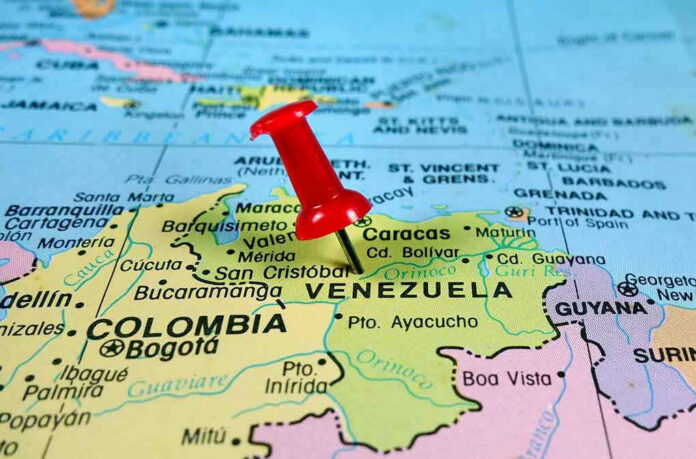
When a 7.5-magnitude earthquake leveled parts of Venezuela on June 24, 2026, the U.S. military moved faster and harder than almost anyone expected — and the reason it could is a story that starts long before the first tremor hit.
Story Snapshot
- Twin earthquakes struck Venezuela on June 24, 2026, and the interim Venezuelan government formally asked the U.S. for help within hours.
- U.S. Southern Command deployed 150 first responders, 12 search dogs, warships, and C-17 transport aircraft to deliver aid and locate survivors.
- Secretary of State Marco Rubio announced $150 million in aid, directed to faith-based groups and two United Nations agencies.
- Damaged Caracas airport runways forced the U.S. to rely on military helicopters and amphibious ships instead of faster fixed-wing cargo flights.
A Formal Request Changed Everything
Venezuela’s interim government formally asked the United States for disaster help within hours of the earthquakes striking. That single act unlocked the full weight of U.S. military logistics. U.S. Southern Command (SOUTHCOM) confirmed the request and immediately stood up an operational planning team staffed with disaster relief experts. [1] Without that request, none of what followed would have been legally or diplomatically possible — a fact worth keeping in mind when critics frame the response as politically convenient.
Had Nicolas Maduro still been in power, former military emergency preparedness liaison Hal Kemper said flatly that U.S. assistance would almost certainly have been turned away. [6] That is not spin — it is the documented history of U.S.-Venezuela relations. The change in government did not manufacture the disaster. It simply removed the barrier that would have left Venezuelans to die waiting for help that Maduro’s pride would have blocked at the border.
What the U.S. Actually Sent Into Venezuela
The hardware and manpower committed here is not a token gesture. SOUTHCOM directed two Air Force C-17 Globemaster transport aircraft to fly Urban Search and Rescue teams from Los Angeles and Fairfax, Virginia, directly into Caracas. [2] Virginia Task Force 1 alone put 80 Fairfax County first responders on Venezuelan soil, alongside six trained search dogs. [5] The California team added 70 more specialists and another six dogs. These are elite teams that train for exactly this kind of collapsed-structure rescue work.
On the water, the amphibious transport ship USS Fort Lauderdale and the littoral combat ship USS Billings arrived in Venezuelan waters to support sealift operations. [2] Three Army CH-47 Chinook helicopters flew in from Soto Cano Air Base in Honduras to move personnel and supplies into communities cut off by the disaster. U.S. Space Force provided satellite imagery to disaster planners on the ground, helping them identify where survivors were most likely trapped and where supplies were most urgently needed.
Damaged Runways Forced a Slower, Harder Delivery
The Caracas airport took damage in the earthquakes, and that created a real bottleneck. Fixed-wing cargo planes could not land at full capacity, which pushed the early supply effort onto slower rotary-wing aircraft and amphibious ships. [7] Marine Corps MV-22 Osprey aircraft flew in an airfield assessment team to evaluate the runway damage and restore operations as quickly as possible. Both hospital ships, the USNS Comfort and USNS Mercy, were unavailable due to scheduled maintenance, further limiting large-scale medical treatment on site. These are genuine constraints, not excuses.
America is sending a lot of heavy lifting. Virginia Task Force 1, that’s about 80 people and six search dogs with 70,000 pounds of gear, flew down on Air Force C-17 Globemaster IIIs, same for teams from LA and Miami. We’ve also got three Army CH-47 Chinook helicopters for moving… https://t.co/1t8hmicrHU pic.twitter.com/fSomjPPgZ6
— Patricia 🇺🇸 (@1109Patricia) June 28, 2026
Communications across Venezuela remained severely disrupted, making it hard to get accurate casualty counts or pinpoint exactly where medical aid was most needed. [6] That kind of information blackout slows everything down — aid workers cannot target resources they cannot track. The U.S. military’s satellite imagery capability partially offset this problem, but ground-level communications gaps are not something orbital assets can fully fix.
$150 Million and the Faith-Based Aid Debate
Secretary of State Marco Rubio announced $150 million in U.S. aid, allocated to faith-based organizations including Samaritan’s Purse and Catholic Relief Services, along with two United Nations agencies. [3] Some critics immediately questioned whether routing money through faith-based groups reflects ideology over neutrality. That criticism deserves a clear-eyed look. Both Samaritan’s Purse and Catholic Relief Services have decades of on-the-ground disaster response experience in Latin America. Choosing proven operators with existing infrastructure in the region is common sense, not a political favor.
Allies Showed Up Too — This Was Not a Unilateral Play
France sent 85 search and rescue specialists. Spain deployed its Military Emergency Unit. Italy readied air force assets. Germany committed up to six transport aircraft. El Salvador’s president sent 300 rescuers and paramedics. [4] The breadth of this international response undercuts the narrative that U.S. military involvement is a cover for geopolitical expansion. When France, Germany, and Italy are all sending planes and teams to the same disaster zone, calling it an American land grab strains credibility well past the breaking point.
Sources:
[1] Web – “Partnerships in action to save lives.”
[2] Web – US military helping plan Venezuela earthquake relief – Task & …
[3] Web – U.S. Military Support to Venezuela Earthquake Relief – southcom
[4] Web – U.S. pledges generous earthquake relief to Venezuela – NPR
[5] YouTube – US airplane loaded to help quake rescue efforts in Venezuela
[6] Web – International community pledges aid to Venezuela after earthquakes
[7] Web – US airplane loaded to help quake rescue efforts in Venezuela SH …
© conservativehub.com 2026. All rights reserved.