

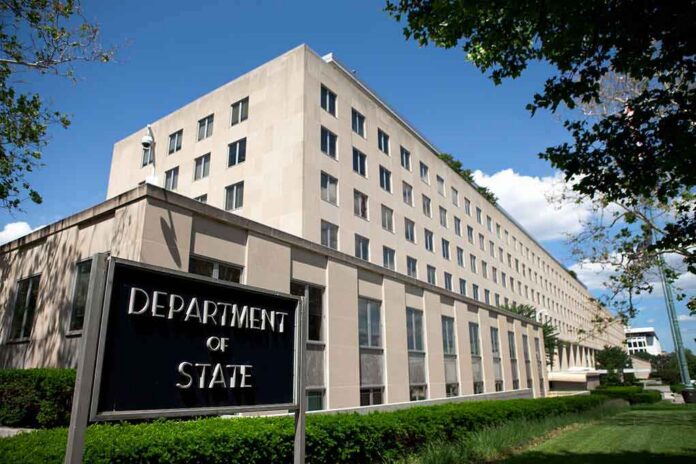
The United States just told the world it will tear down the International Criminal Court, brick by brick.
Story Snapshot
- Secretary of State Marco Rubio launched a whole-of-government push to dismantle the court.
- Washington says the court threatens American troops, border agents, and officials.
- Tools include visa revocations, travel bans, and expanded sanctions on court personnel.
- Critics counter there is no active case against Americans at the court today.
Rubio turns sovereignty into policy, not a slogan
Marco Rubio put U.S. sovereignty at the center of foreign policy on July 13, 2026. He announced a diplomatic and economic campaign to dismantle the International Criminal Court’s reach, “brick by brick.” He framed the court as using laws to wage war on the United States. The State Department rolled out the plan across official channels and social media the same day, matching his message with an action list and global targets.
The government’s focus lands on risk to Americans in uniform and in enforcement roles. Officials cited a need to block any path where court prosecutors could claim power over U.S. service members abroad or agents carrying out immigration law. The State Department described the goal plainly: make the court incapable of threatening U.S. sovereignty or targeting Americans for doing their jobs under U.S. law.
The pressure campaign: sticks first, then bigger sticks
The plan uses familiar hard tools. Washington will revoke visas, impose travel bans, and widen sanctions on court officials and the groups that help them. These steps mirror past sanctions approaches that hit wallets, movement, and prestige. The administration also plans to press allied governments to pull funding and distance themselves from the court, tying future U.S. aid to cooperation with the campaign, according to contemporaneous reports.
Diplomats will work country by country. The pitch: stand with the United States on sovereignty, or risk losing some U.S. support. Many partners are members of the court, which sets up a stress test inside alliances. Defense ties, intelligence sharing, and aid could all feel strain if governments resist. This is not a one-week media cycle. It is an organizing principle for how Washington plans to engage friends and fence-sitters alike.
What the court is, and what it is not
The court sits in The Hague and prosecutes the worst crimes: genocide, war crimes, crimes against humanity. It claims jurisdiction when national systems cannot or will not act. The United States is not a member of the court’s founding treaty. That matters for most cases on U.S. soil, but it does not end the legal debate over acts by Americans in member countries. That gray zone is where sovereignty arguments heat up.
Former court officials and many media reports say there is no current investigation of Americans and none in the court’s history. They argue the “imminent threat” claim stretches the facts. They also note that the United States has worked with the court before, including on cases in Darfur and Libya, which challenges the idea that cooperation always harms U.S. interests. These points do not erase the legal risks, but they lower the temperature on “right now”.
The conservative case: draw a bright line and defend it
American conservatives read the court’s model as a structural risk. If a prosecutor in The Hague can claim power over U.S. citizens without U.S. consent, then a core principle breaks. The Department of Justice has said as much: a treaty cannot bind a country that did not consent to it. That line is clear, and defending it is a matter of constitutional duty, not public relations or mood.
🚨LIVE NOW
Marco Rubio says it's time to take a wrecking ball to the International Criminal Court. But what is the ICC, what power does The Hague actually have, and why has the U.S. fought it for decades? @realNickCooper breaks down the battle over sovereignty, war crimes, and… https://t.co/wXwP1tPSW9
— 🥷🦅Austin Wade Petersen 🇺🇲🥋 (@AP4Liberty) July 15, 2026
Policy should match that line. Sanctions and visa bans signal that attempts to reach into U.S. affairs have a price. Pushing allies to rethink funding the court aligns money with values. Critics reply that there is no active case and that the court is a backstop for the worst crimes. That stance underplays how fast legal theories travel once they gain a foothold. Bright lines fade if we let exceptions harden into practice.
What to watch next: metrics, not moods
Three scorecards will tell whether this campaign works. First, whether court officials step back from theories that touch U.S. personnel. Second, whether key allies freeze or cut funding, or issue new bilateral pacts that shield U.S. citizens. Third, whether sanctions bite: canceled travel, frozen assets, and stalled cooperation by court-linked groups. If these move, the court’s reach shrinks. If they do not, Washington will face a choice: raise the cost, or recalibrate.
Sources:
youtube.com, news.meaww.com, facebook.com, fidh.org, humanrightsfirst.org, bbc.com
© conservativehub.com 2026. All rights reserved.