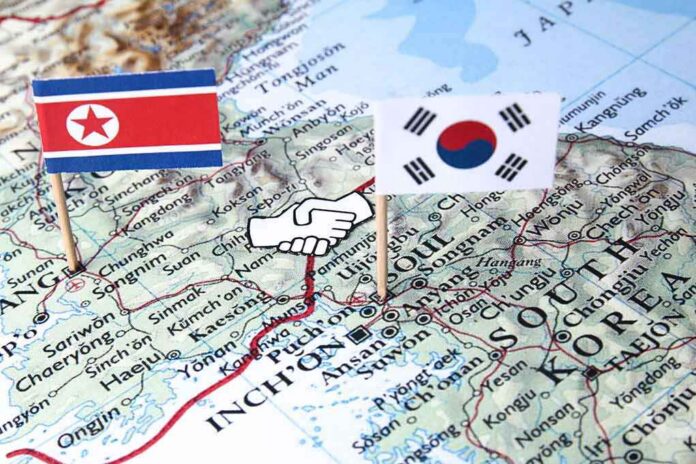
South Korea’s president just asked North Korea, the United States, and China to sit down and finish a war that never officially ended.
Story Snapshot
- President Lee Jae-myung urged talks to replace the armistice with a peace deal.
- The plan seeks to slow or halt North Korea’s nuclear gains through structured dialogue.
- Pyongyang has brushed off Seoul’s proposals and slammed ties with Washington.
- Conservatives at home call the approach weak and push stronger deterrence.
Lee’s Overture: End the War, Build Guardrails
President Lee Jae-myung used Liberation Day to propose direct talks among the Koreas, the United States, and China to replace the 1953 armistice with a formal peace regime. He tied the effort to practical steps to halt North Korea’s nuclear advances, signaling a mix of diplomacy and hard security checks inside a rules-based framework. South Korean coverage underscored his aim to curb escalation risk while keeping the door open to confidence-building measures and phased restraint on weapons programs.
Lee’s team has floated a “peace-first” policy track, arguing that cold silence only feeds miscalculation. The Unification Ministry earlier backed a peace declaration to restart dialogue channels and lower the chance of sudden clashes along the Demilitarized Zone or at sea. The concept echoes past scholarship on step-by-step peace structures that balance political pledges with verification, timelines, and outside guarantees to keep both sides honest and responsive.
North Korea’s Flat Rebuff and the Washington Factor
North Korea has not welcomed the pitch. Reporting shows Pyongyang says it has no interest in talks under Seoul’s terms and accuses Lee of staying confrontational by keeping close ties with Washington. That line signals the usual playbook: blame the alliance to justify stalling while pushing ahead on missiles and nuclear warheads, then demand sanctions relief up front. The message lands as a pressure tactic, not a peace plan, and leaves Seoul carrying the public burden of initiative.
That posture also sets up a test. If Pyongyang keeps firing missiles or staging military shows, Seoul’s call for dialogue will look one-sided. A credible framework would need clear conditions: stop tests during talks, allow third-party monitoring, and sequence any economic steps to real nuclear limits. Without that, a summit becomes a photo op. With it, the talks could fence in risk while the broader issues get hammered out over time.
Homefront Blowback: Rallies, Hard Lines, and Red Lines
Conservative voices in South Korea frame Lee’s outreach as naïve or dangerous. A vocal slice demands stronger deterrence and even debates on bringing back United States tactical nuclear weapons or pursuing a North Atlantic Treaty Organization-style nuclear-sharing plan. One leading conservative platform skipped dialogue altogether and stressed building options that keep Seoul in control if Pyongyang sprints ahead with its arsenal. That reflects a clear red line: do not reward threats; meet them with strength.
Broader conservative critiques argue that aid or early concessions would only fuel North Korea’s weapons programs. That aligns with a common-sense view shared by many American conservatives: peace rests on peace through strength, firm verification, and zero tolerance for nuclear blackmail. Claims that dialogue should outrank missile defense deployments meet sharp pushback as “unrealistic and illogical,” with calls to hold deterrence steady until provocations stop for real, not just in words.
The Shadow of the Drone Scandal
A separate political storm adds friction. Courts this year sentenced ousted President Yoon Suk Yeol to 30 years over a covert drone operation tied to a domestic martial law plot, a ruling that stunned the country and widened partisan divides. The verdict sharpened arguments over deterrence versus provocation and reset the debate on who owns “security credibility” in Seoul’s halls of power. The case now hangs over every move on the North Korea file.
Prosecutors and reporters detailed how the drone caper allegedly aimed to spike tensions for political gain, undercutting public trust in tough-on-the-North rhetoric that lacks clean accountability. The shock verdict did not erase the core concern—North Korea’s growing threat—but it did nudge voters to ask for discipline, transparency, and guardrails at home. That public mood could either harden against risky gambits or press leaders to seek verifiable outcomes at the table.
What A Workable Peace Track Would Require
Any serious end-of-war process must demand basic steps from Pyongyang: halt testing during talks, freeze fissile material output under monitoring, and commit to phased rollbacks tied to relief steps that can snap back. The talks must protect allied readiness, keep joint drills smart and steady, and lock in firm penalties for violations. Such a design matches conservative common sense: reward only real compliance, keep strength visible, and let peace serve security, not replace it.
Sources:
bbc.com, apnews.com, bloomberg.com, koreaherald.com, koreatimes.co.kr, whbl.com, washingtonpost.com, aljazeera.com, upi.com
© conservativehub.com 2026. All rights reserved.