

Two Sullivans on one ballot set off a federal lawsuit, a GOP family fight, and a late-night Trump broadside.
Story Snapshot
- Justice Department moved to block certification if duplicate-name confusion could flip Alaska’s Senate race.
- President Trump said he personally ordered the lawsuit, making it a White House-level call.
- Senator Lisa Murkowski said Alaska’s ballot already solved the confusion and blasted the case.
- Alaska labeled the incumbent “Dan S. Sullivan” and the other “Daniel J. Sullivan Jr.” with no party tag.
The Lawsuit That Hinged On One Name
The Department of Justice targeted a specific election risk, not a theory. Alaska’s Senate ballot listed two men named Sullivan. The agency said Daniel J. Sullivan Jr. appeared designed to trick voters who meant to pick Senator Dan Sullivan. The complaint asked a court to stop certification only if the math showed those votes could have changed the outcome under ranked choice rules. That narrow trigger focused on remedy, not rhetoric, but it guaranteed a political firestorm.
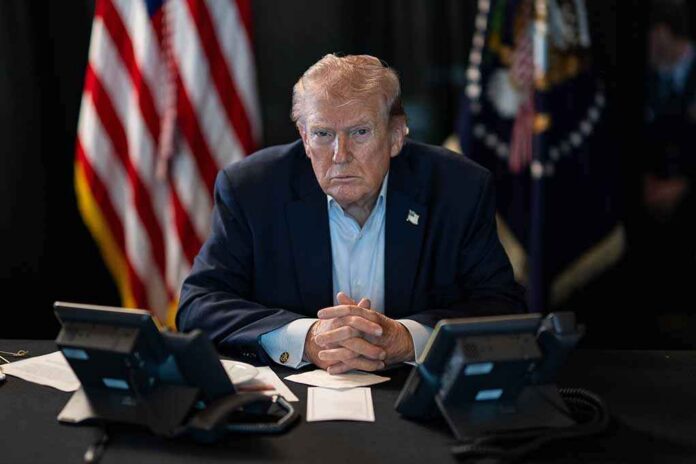
President Trump removed any doubt about who pressed go. He told reporters, “I’m the one that said do it.” That line put the Justice Department’s move squarely on the President’s desk. Supporters call this leadership. Critics call it pressure on state election systems. Both can be true in politics. The real test is whether the facts on the ballot justified federal action after Election Day. The White House bet voters could be misled by identical surnames in a close race.
What Alaska Put On The Ballot To Cut Confusion
Alaska officials did not ignore the surname problem. The ballot flagged the incumbent as “Sullivan, Dan S” and marked him as a registered Republican and the sitting officeholder. The other man appeared as “Sullivan, Daniel J Jr” without a party label. This design choice gave voters several cues: first name, middle initial, incumbent marker, and party for only one candidate. Under Alaska’s ranked choice system, a confused voter could rank both, which softens the harm of a stray first-choice mark.
Senator Lisa Murkowski leaned on those facts to reject the case. She said the state “already handled this” by clearly distinguishing the candidates and that the Department of Justice should never have filed the lawsuit. That stance fits a conservative instinct: local officials manage local ballots. It also nods to federalism. If the state changed the ballot to address confusion and its courts allowed both men to run, many Alaskans will ask why Washington, D.C., should referee their count at the buzzer.
Trump’s Attack, Murkowski’s Rebuttal, And The Conservative Lens
Trump blasted Murkowski as a disgrace. The evidence does show a real ballot risk and a tailored remedy. But it does not show that Murkowski acted in bad faith. Her claim rests on visible ballot fixes and the safety valve of ranked choice transfers. On the merits, both sides cite fairness: the President frames it as protecting voters from a look-alike spoiler; the Senator frames it as protecting state control and a clean certification. Common sense says two truths collide here.
First, voter clarity matters. Two Sullivans can mislead in a tight race. Second, rules should not shift after voters cast ballots. A remedy that triggers only if one side loses will look partisan, even if the math supports it. A cleaner path, favored by election pros, is to resolve name disputes before voting starts. Alaska’s Supreme Court had already let both men appear, which made a late federal stop sign a hard sell to many voters. Courts generally dislike moving end zones mid-game.
What To Watch Next: Proof, Not Posts
The question that decides this fight is simple: did confusion actually alter the result? The lawsuit points to intent and risk. The state points to labels and process. Hard evidence would look like sworn voter statements, precinct patterns that swing with name order, or ranked choice files showing decisive misfires. Without that, the dispute becomes a referendum on federal reach versus state control. That is terrain where Alaskans, and conservatives broadly, default to the state.
#AKSen: Trump late Saturday: "Lisa Murkowski is a DISGRACE to Alaska and our Country." He urged "YES" on Ballot Measure 2, a ranked choice repeal. Murkowski (R) on DOJ's two-Sullivans suit: "The Department of Justice should never have filed this lawsuit." https://t.co/YTyRJoEsXB pic.twitter.com/gkRKD3yrpi
— Center Aisle News (@CenterAisleNews) October 25, 2026
Here is the practical takeaway for future races. States should set bright-line naming rules before ballots lock: middle initials required when surnames match, party tags for all candidates, and incumbent flags when lawful. Campaigns that mimic a rival’s name or branding should face fast-track review. And if risk remains, courts should fix it before voting, not after. That approach honors voter intent, limits courtroom drama, and keeps Washington out of state counts unless fraud is proven.
Sources:
timesunion.com, nbcnews.com, ksbw.com, yahoo.com
© conservativehub.com 2026. All rights reserved.