
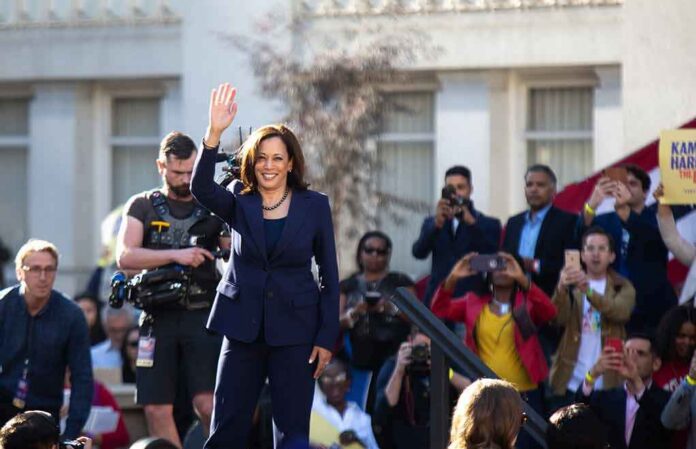
Kamala Harris drew headlines in Columbus, Mississippi, after a clumsy motivational line landed flat and the room went quiet.
Story Snapshot
- Harris rallied with Senate candidate Scott Colom in Columbus on October 22, 2026.
- Organizers moved the event to Columbus High School after a venue change earlier that day.
- The stop fit Harris’s late push through key states in the midterm homestretch.
- Local promotion billed the rally as a turnout jolt ahead of November.
What Happened In Columbus
Kamala Harris joined Democratic Senate candidate Scott Colom for a Thursday evening rally in Columbus, Mississippi, on October 22, 2026. Newsweek and local broadcasters listed the stop on her schedule and placed her in Columbus that day. The Colom campaign promoted the event as a high-energy community rally to drive voter turnout in the final stretch. Harris spoke about national themes and Mississippi concerns while urging supporters to back Colom against Republican Senator Cindy Hyde-Smith.
During her remarks, Harris delivered a motivational line that did not land as planned. The moment drew notice because the phrasing felt off, and the audience response was muted. Campaign events often hinge on rhythm and rapport. A single awkward beat can grab attention when cameras roll and clips spread. The Columbus setting, with a gym crowd and hard echoes, heightened that effect. The stumble did not change the rally’s goal: energize volunteers and spotlight Colom’s case to voters.
The Venue Change And Why It Mattered
Organizers shifted the rally from a university site to Columbus High School after the Mississippi University for Women declined to host due to logistics that day, according to local reporting. Venue changes can alter everything: stage layout, crowd flow, acoustics, and the feel of call-and-response lines. A gym can swallow sound and make even supportive crowds seem quieter. That practical wrinkle helps explain why a flat line stood out more than usual in a late-October campaign push.
Even with the switch, the Colom team kept the program intact and kept Harris on the Mississippi schedule. The event remained a central part of the campaign’s argument that the race was competitive and deserved national attention. Local outlets had trailed Harris’s Mississippi swing, including a second stop in the state that day, placing the rally within a broader tour built to touch regional issues while tying them to national contrasts on the economy, health care, and public safety.
Why The Moment Drew Outsized Attention
Modern campaigns live on short clips. A clipped pause or awkward line can eclipse a full speech. Media researchers call this a “cheap fake” or context collapse risk—real footage, framed to amplify one beat and bury the rest. The Columbus clip fit that pattern. It traveled because it was simple, emotional, and easy to share. That does not make the reaction fake. It does show how a small stage moment can outweigh policy points in the attention economy.
"These people in Washington are trying to make you feel powerless and alone. You have Scott Colom, and he will fight for you. The people of Mississippi have a choice. Don't let anybody tell you who you are, you tell them who you are." – Kamala Harris pic.twitter.com/h2Fyd75xNU
— Fabi 🪷 (@kamala_things) October 23, 2026
Strategically, the Mississippi stop still served a standard purpose. National figures lend energy, press, and money to a state race that needs a turnout edge. Harris’s presence signaled that Democrats saw a path, while Republicans moved to protect the seat. Voters often judge these visits less by one-liners and more by whether the visit signals investment. On that count, the Columbus rally delivered what campaigns want in late October: cameras, content, and a message handoff to local organizers.
What Comes Next In Mississippi
Scott Colom continues to center cost of living, health coverage, and a contrast on governing style. Cindy Hyde-Smith relies on name recognition, incumbency, and alignment with Mississippi’s conservative tilt. National surrogates will keep cycling through, because outside attention can free up resources and volunteers in the final sprint. The Columbus episode will likely stay a footnote unless it repeats. Most races in the last two weeks turn on field work, not clips.
Sources:
drooid.social, newsweek.com, wtva.com, x.com, supertalk.fm, magnoliatribune.com, apnews.com
© conservativehub.com 2026. All rights reserved.