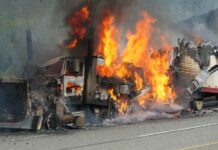


Toledo firefighters drew a one-mile line in the night and told thousands to move, fast.
Story Snapshot
- Toledo Fire & Rescue ordered a one-mile evacuation around Progress Avenue after a chemical release.
- Officials also told people within three miles to shelter in place and shut off outside air.
- Shoreland Elementary opened as a shelter; buses and the Red Cross staged nearby for evacuees.
- Early reports named Sterling Pipe & Tube; later coverage pointed to MC Tank on Progress Avenue.
Evacuations, sirens, and a midnight perimeter
Toledo Fire & Rescue ordered everyone within one mile of 1050 Progress Avenue to evacuate at 10:48 p.m. on October 20, after crews reported a hazardous-materials release in North Toledo. Roadways fell under a thick haze and drivers slowed through low visibility. The one-mile evacuation was not a suggestion; it was a life-safety order based on conditions the incident commander could see and smell in real time, backed by city alerts and repeated across major outlets.
People outside the circle got a different message. Residents within three miles were told to stay inside, close windows and doors, and shut down any system that pulls in outside air. That split approach is standard playbook for chemical events when the exact substance and release rate are not yet nailed down. Federal guidance says leaders must balance wind, time, and traffic to reduce exposure, and sometimes the right answer is mixed protection zones.
Coordinated lift: shelters, buses, and neighborhood sweeps
Evacuation orders are only as strong as their logistics. The city opened Shoreland Elementary School as a temporary shelter. Regional buses and the American Red Cross mobilized at the Meijer lot on Alexis Road to move people and cover basic needs. Local officials also flagged two nearby communities at risk. Raintree Village mobile home park and the Alexis Addition neighborhood sat in the evacuation zone, and Washington Township joined the door-knock and transport push.
That visible haze spooked drivers for good reason. Chemical releases can cling to cool night air and form a ground-hugging cloud that cuts sightlines and irritates lungs. Video showed low visibility on key roads as the plume mixed with fog. That kind of street-level hazard can justify fast perimeter calls even before lab data comes back. Commanders do not get the luxury of waiting when tail lights disappear in the murk.
Which facility, which tank, which street number?
Early reports tied the incident to Sterling Pipe & Tube at 1050 Progress Avenue. Later coverage said the source traced to MC Tank at 1266 Progress Avenue and described the earlier identification as incorrect. That shift is not rare in first-light reporting. The scene spans industrial addresses on the same corridor, and responders prioritized life safety over perfect corporate mapping. The operational orders—evacuate one mile, shelter three—did not hinge on a logo on a fence.
Officials did not name the chemical during the first alerts. That lack of detail can frustrate the public, but it fits how chemical emergencies unfold. The job in hour one is to move people out of harm’s way and seal buildings downwind. The Emergency Response Guidebook exists for this reason: it gives responders conservative distances when identity, quantity, and release rate are still unclear. Better to clear extra blocks than gamble lives on guesswork.
How the call squares with common-sense risk
A one-mile evacuation is a blunt tool, but it is recognizable and fast to explain. Families can picture it, pack up, and go. A three-mile shelter order keeps roads freer for fire crews and prevents more people from driving into the cloud. This balance reflects American conservative values in crisis: protect life first, use simple instructions, and lean on local judgment closest to the facts. That is what Toledo’s on-scene leaders did when the haze thickened and minutes mattered.
A chemical leak late Tuesday night in Toledo, Ohio, prompted a 1-mile evacuation zone while hazmat crews responded to the scene. https://t.co/W6YUtmX2XX
— KIII 3 News (@kiii3news) October 21, 2026
When the sun came up, investigators worked the why and how. City updates and local reporting confirmed the orders, the shelters, and the neighborhoods affected. The cause, tank specifics, and measured concentrations will sort out through reports and testing, but the public actions were clear. Crews set a one-mile hard line, told the wider area to seal up, and staged transport and shelter support. That is the picture that counts when the night air turns sharp and the streets go gray.
Sources:
thegatewaypundit.com, cbsnews.com, cleveland.com, thehill.com, yahoo.com, mercercountyoutlook.net
© conservativehub.com 2026. All rights reserved.