

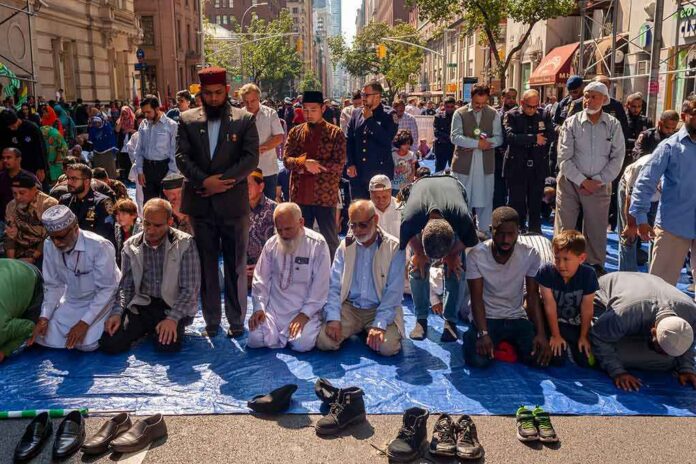
Pew Research Center projects Muslims will surpass Christians worldwide by 2035, reshaping the global religious map.
At a Glance
- Muslims are projected to outnumber Christians globally by 2035.
- By 2070, Muslims could exceed 3.6 billion; Christians just under 3 billion.
- Fertility gaps drive most of the change, not conversions.
- The United States is projected to lose its Christian majority by 2070.
What Pew Says Will Happen and When
Pew’s new projection draws a clear line: the global crossover arrives by 2035. Both faiths grow in absolute numbers, but Muslims grow faster. The published 2070 totals place Muslims above 3.6 billion and Christians just shy of 3 billion, with Muslim growth around 80% from 2020 and Christian growth about 30% over the same span. The result is directional, not a cliff. The 2035 year marks when the lines cross, not when one faith stops growing.
The United States remains majority Christian for decades but not forever in the main scenario. Pew’s model shows the U.S. Christian share falling below 50% by 2070, while Christians still remain the largest single group. The religiously unaffiliated grow, driven in part by switching among younger cohorts. The same report lists Christians as a majority in 110 of 201 countries and territories in 2070, showing wide geographic variation.
Why The Lines Cross: Babies, Ages, And Switching
The engine is basic demography. Muslim populations tend to be younger and have more children per woman than Christian populations. That gap in fertility explains most of the projected change between 2020 and 2070. Pew states that natural increase—births minus deaths—accounts for most shifts, while religious switching plays a secondary role at the global level. The model assumes within-country fertility gaps slowly narrow as we move toward 2100.
Migrants matter in places, but fertility and age structure do the heavy lifting worldwide. The model tracks each five-year cohort forward, adds expected births, and subtracts expected deaths. It then layers migration flows and observed switching patterns by country. This is a cohort-by-cohort build, not a headline guess. Pew’s team applied the method across 201 countries and territories, using the best available census and survey baselines for 2020 before stepping into future years.
America’s Trajectory: Slower, But Still Downward
The United States does not mirror the world. Muslims will not become the largest U.S. group in this horizon, but Christians slip below a majority by 2070 in the main case, with the unaffiliated gaining share. That matters for culture, law, and policy debates that assume a stable Christian majority. The United States still has more churches than any nation, but membership trends and lower Christian fertility reduce the share over time in the model.
A major shift in the world's religious landscape could take place over the next decade. According to a new projection by the Pew Research Center, Islam is expected to overtake Christianity and become the world's largest religion by 2035.
The study projects that the global Muslim… pic.twitter.com/62XSCAF31M
— 𐙚 𝒑𝒊𝒌𝒖 🍀 (@Praghav444) November 19, 2026
Conservatives will read this as a scoreboard for family formation and renewal. The lesson aligns with common sense: groups with more children and stronger retention grow. Faith communities that marry, have kids, and keep their young adults tend to expand. Those that delay marriage, avoid children, or lose teens to secular life shrink. Pew’s math simply tallies that reality across decades, countries, and age bands.
How To Read A Projection Without Getting Spun
These are conditional projections, not prophecies. Pew models what happens if recent patterns continue and if fertility gaps slowly narrow by 2100. Different migration policies, shocks, or cultural revivals could shift the lines. That said, fertility and age structure change slowly. The 2035 crossover year might slide a bit, but the direction is robust unless trends flip. The right takeaway is preparation, not panic or denial.
Practical leaders will focus on what they can control. Pastors and parents can invest in young families and catechesis to improve retention. Policymakers who value civil society can remove penalties on marriage and childbearing. Civic groups can welcome immigrants while helping them thrive within shared national norms. Demography is not destiny, but it is a long fuse. The choices made now ripple through the pews and neighborhoods of 2050 and 2070.
What To Watch Next
Watch fertility trends in key countries with large Muslim and Christian populations. Track youth retention in North America, Europe, and Latin America, where switching away from Christianity has been steep. Monitor migration rules in destination nations that shape community size and age. Finally, follow Pew’s country-level tables as they release more slices of the dataset and tools for replication. The organization says the full data and model resources are public for scrutiny.
The headline is simple, but the story is layered. The global crown shifts by 2035. The U.S. majority tips by 2070. Babies, ages, and belonging decide the curve more than speeches do. That is not a crisis narrative. It is a call to build families, form communities, and teach the next generation what you hope to see still standing when the calendar reads 2070.
Sources:
thegatewaypundit.com, pewresearch.org
© conservativehub.com 2026. All rights reserved.