
On one April morning, a jihadist coalition struck Mali from the capital’s doorstep to its far north—and then claimed to seal the capital shut.
Story Snapshot
- Coordinated attacks hit Kati, Sévaré, Mopti, Gao, Kidal, and near Bamako’s airport on April 25, 2026.
- Mali’s defense minister was reported killed in a car bomb at his Kati residence.
- Al-Qaeda–linked JNIM declared a blockade of Bamako days later, aiming to choke movement and trade.
- Analysts chart years of jihadist spread across Mali and into coastal states despite foreign aid.
What Changed On April 25: From Outlands To The Capital’s Gate
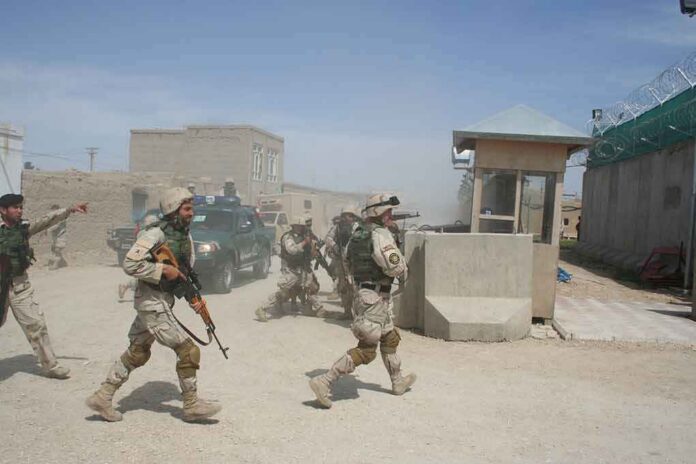
Jama’at Nusrat al-Islam wal-Muslimin, known as JNIM, showed reach and timing that surprised even seasoned watchers. Attacks landed the same day across central, northern, and peri-urban zones, including Kati, the military nerve center just outside Bamako. European security researchers called the pattern a coordinated challenge to state authority. Radio France Internationale described strikes on army positions near Bamako and in the north. This was not random violence; it was a synchronized test of the junta’s core.
The shock deepened when reports said Defense Minister General Sadio Camara died in a car bomb at his home in Kati. Human Rights Watch cited multiple accounts tying the killing to the offensive. State media announcements, echoed by international outlets, marked a rare loss of a top defense leader in his own stronghold. Such a hit rattles chains of command and morale. Claims in war can be messy, but the reporting on Camara’s death came with official confirmation at the time.
The Blockade Claim: A Capital Under Squeeze
Three days later, a JNIM spokesman declared Bamako under “total siege.” The message promised no entry. The next reports showed harassment of civilian traffic and strikes on routes into the city. The blockade’s exact reach varied by source, with phrases like partial or total used in turn. But the point landed: a jihadist group felt confident enough to announce a chokehold on a capital and to act on it, at least in parts of the access network.
The junta did not fall. Le Monde reported the attackers failed to overthrow the rulers. Yet the siege posture pinned the government in a defensive crouch. A regime that must guard every road into its capital cannot restore rural order. It only reacts. That is how insurgents win time and space: stretch the state, force choices, then strike where patrols thin out. The April wave followed that playbook while the world watched Bamako’s gates.
Years In The Making: Expansion, Alliances, And New Fronts
Analysts at the Africa Center for Strategic Studies traced this moment to years of expansion. JNIM pushed from northern and central strongholds into western and southern Mali. It hit bridges, roads, and economic corridors instead of only outposts. That shift hurts markets and scares truckers, which raises prices and saps trust in the state. European researchers also tracked JNIM operations into coastal West African states like Benin, proof that “containment” became a map of moving brushfires.
The April communiqué added another twist: JNIM acknowledged alignment with the Azawad Liberation Front, a separatist outfit. Radio France Internationale reported simultaneous strikes by both. That does not make them one force, but it shows a coalition of convenience. Jihadists bring shock and mobility. Separatists bring local ties and terrain sense. Together they gain options. That cocktail has troubled counterinsurgencies from Afghanistan to the Sahel for two decades.
Why Foreign Help Has Not Fixed It—And What That Says About Strategy
United States reporting describes a hard theater: rough terrain, very long borders, weak state presence, and rival jihadist groups fighting each other while expanding. The United States and European partners have trained, equipped, and advised regional forces. They have focused on bombs, border control, and money flows. Those steps matter. But the record shows jihadist reach grew anyway. The problem looks less like a missing tool and more like a broken system with coups, abuses, and poor governance baked in.
Some argue militant rivalry itself fuels spread, not just state weakness. Spanish defense analysis says JNIM and the Islamic State branch have fought each other for turf since 2020. That fight can displace groups, shift routes, and push violence into new zones, including toward the Gulf of Guinea borders. Rivalry does not help civilians, and it does not make a national army’s job easier. It multiplies fronts and scrambles signals about who controls what.
The Conservative Read: Clarity, Accountability, And Measurable Results
Taxpayers deserve proof of results, not slogans. The April attacks and the siege claim show that tactics without political reform do not secure a country. Aid should demand hard metrics: secure roads open a set number of days, market prices stable, schools staffed and safe, and local justice that is fast and fair. Training forces that cannot or will not protect civilians is a dead end. Fund what works, cut what fails, and publish scorecards citizens can read.
Three tests would bring clarity now. First, map real control: roads, checkpoints, taxes collected, and services delivered, week by week. Second, verify the Bamako blockade’s scope with satellite images, fuel prices, and truck manifests. Third, release declassified evaluations of assistance programs so voters can see what helped and what hurt. If partners cannot meet basic standards, shift resources to communities and corridors that can be secured and held. Strategy must serve outcomes that families feel every day.
Sources:
reason.com, lemonde.fr, hrw.org, bbc.co.uk, iss.europa.eu, rfi.fr, en.wikipedia.org
© conservativehub.com 2026. All rights reserved.