
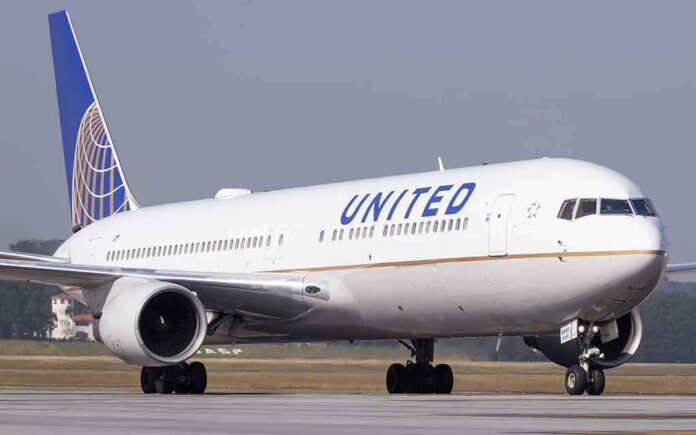
A flight attendant’s quick glance at a phone and five words—“gonna hijack this plane”—turned a routine climb-out into a race back to the runway.
Story Snapshot
- A United Las Vegas–to–Newark flight returned after a reported hijack text was seen by crew.
- Pilot told controllers the message referenced hijacking and crashing a row.
- Police arrested 25-year-old Dante Milne on a terrorism-related threat charge.
- No injuries reported; passengers and crew later continued travel safely.
Cabin sighting, cockpit call, and a swift return
The sequence started minutes after takeoff from Las Vegas. A flight attendant reported seeing a passenger’s phone with a message that mentioned hijacking. The captain radioed air traffic control that the crew member saw a text stating the sender was going to hijack the aircraft. Controllers cleared the return. The jet turned back about ten minutes after departure and landed without incident. United described the situation as a potential security concern and kept procedures tight and calm.
Reports attribute sharper language to the criminal complaint, including “gonna hijack this” with an expletive, and “crash ur row only.” That phrasing moved the risk from vague chatter to a direct threat that any captain must treat as real until proven otherwise. The cabin crew escalated. The cockpit executed the plan. Law enforcement met the aircraft at the gate. No passengers were hurt, and the situation remained controlled from the moment the cockpit made the call.
From runway to handcuffs: how police framed the offense
The Las Vegas Metropolitan Police Department detained and booked 25-year-old Dante Milne after the plane returned. Police listed the offense as making a threat or providing false information about an act of terrorism, a state charge with serious penalties. News reports identified a bond of ten thousand dollars and a court appearance. The charge does not require a weapon or a cockpit rush; the alleged threat itself triggers the response and the legal exposure in Nevada.
The aviation chain worked as designed. The flight attendant flagged the risk. The pilot declared the concern to controllers. Airport police secured the aircraft. Federal authorities were notified. That multi-layer posture exists for one reason: speed beats uncertainty at thirty thousand feet. Every step matched modern playbooks born from harder lessons decades ago, when delays in judgment cost lives and aircraft.
Why an ugly text grounds a jet in minutes
Airlines and regulators built today’s rules after a long history of hijackings and close calls. In the 1960s and early 1970s, the United States saw more than a hundred hijackings, a staggering number by modern standards. That history still shapes how crews treat explicit threats in the cabin. Quick returns are not panic; they are policy, designed to move the problem to a secure, well-staffed ramp where police and agents have home-field advantage.
United Airlines 737 Pilots Returns to Las Vegas After Potential Hijack Threat✈️@united Airlines (UA) flight 1681 returned to Harry Reid International Airport (LAS) in Las Vegas on Saturday, October 24, 2026, after a flight attendant reportedly spotted a passenger texting about… pic.twitter.com/pEcqv1UVSD
— Aviation A2z (@Aviationa2z) October 26, 2026
Some readers ask whether this was an overreaction. The better question is what the captain knew at the time. The crew had a direct report of hijacking language and a mention of crashing a row. The cost of a return is measured in fuel, delays, and paperwork. The cost of waiting, if the threat were real, is unthinkable. When safety is the mission, prudence is not fear. It is discipline that aligns with both common sense and American conservative values of order and responsibility.
What happens next and what matters most
Investigators will work the basics: device records, passenger interviews, and timing. Prosecutors will compare the facts to the terrorism-threat statute. Courts will sort intent and context. That process can take weeks. The operational story is already clear. A crew saw a red flag, acted fast, and got everyone home that night. That is the standard we should expect and defend, even when later facts show no more than reckless words at 20,000 feet.
Sources:
cbsnews.com, 8newsnow.com, balleralert.com, ground.news
© conservativehub.com 2026. All rights reserved.