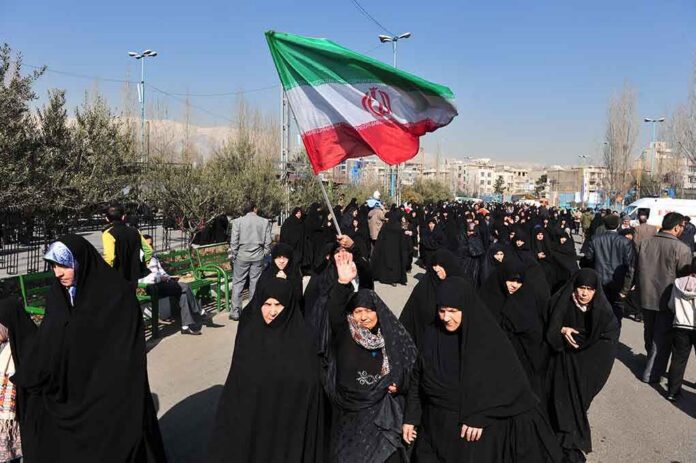
Iran’s loudest voice right now isn’t in the presidential palace or the foreign ministry—it’s in the command rooms of the Revolutionary Guard.
Quick Take
- Iran’s public messaging on war and diplomacy has turned contradictory, signaling fractured authority at the top.
- The death of Supreme Leader Ali Khamenei created a vacuum that the IRGC appears positioned to fill, fast and forcefully.
- Mixed signals from President Masoud Pezeshkian and Foreign Minister Abbas Araghchi clash with continued regional strikes.
- Economic collapse and internal unrest make military-first decision-making more likely, not less.
Mixed Messages Are a Symptom: Who Commands Iran’s Next Move
Iran’s leaders have offered a public script that doesn’t match the actions on the ground. Foreign Minister Abbas Araghchi talked up diplomacy, then rejected a ceasefire line. President Masoud Pezeshkian pledged restraint toward neighbors, then Iran launched drones and missiles toward Gulf states. That gap matters because regimes at war survive by clarity. When the words and the weapons disagree, the most plausible explanation is competing power centers—and the armed one usually wins.
Israel’s reported strikes intensified the leadership crisis by removing figures who could broker internal compromise. The killing of Ali Larijani, a political heavyweight with ties across factions, shrinks the space for negotiated decision-making. The result looks less like a unified “Iran” choosing a strategy and more like an Iran where the tempo follows the IRGC’s threat calculus. When military leadership drives timing, escalation becomes the default, and diplomacy becomes a talking point.
What Makes This Moment Feel “Coup-Like” Even Without Tanks in the Streets
A classic coup features soldiers seizing TV stations. Iran’s version, if it’s happening, would look more procedural: control of succession, control of intelligence, control of retaliation, and control of what civilians are allowed to claim. Reports of the IRGC pushing an extralegal, rapid appointment of a new supreme leader fit that pattern. The key tell isn’t pageantry—it’s bypass. When the normal process becomes an inconvenience, power has already moved.
The death of Ali Khamenei changed the regime’s wiring overnight. Supreme leaders provide arbitration between factions; without one, every hard decision becomes a contest. A contest during an active conflict tends to reward the institution with guns, surveillance, and economic leverage. The IRGC has all three, and it doesn’t need to announce dominance to exercise it. Civilian officials can keep giving interviews; the Guard can keep setting the battlefield. That’s how civilian authority gets hollowed out.
The IRGC’s Real Advantage: A Security Force That Also Runs a Business Empire
The IRGC isn’t only a military organization; it operates like a parallel state with commercial gravity. Over decades, sanctions and isolation created opportunities for black-market logistics and sanction-evasion networks. Analysts have described the Guard’s role expanding into large swaths of the economy, including through foundations and state-adjacent enterprises. That matters because economic power isn’t just wealth—it’s loyalty, payroll, and patronage. A force that can pay people can outlast cabinets that can’t.
Economic pain also reshapes political incentives. Iran’s currency devaluation, inflation pressure, blackouts, and protest cycles create conditions where leaders often choose control over reform. From an American conservative, common-sense perspective, this is the predictable outcome of a system that rewards coercion and punishes accountability. When citizens demand normal life, a security-state apparatus tends to interpret it as a threat. The IRGC’s institutional DNA, built to suppress internal dissent, aligns with that grim logic.
Why Gulf Strikes and Hormuz Pressure Matter More Than Rhetoric
Iran’s attacks toward Gulf states and pressure in the Strait of Hormuz create leverage that civilian diplomats can’t easily dial down without losing face inside the regime. Hormuz disruptions hit global oil flows and raise the economic cost of the conflict for everyone, which the IRGC can use as bargaining power or deterrence. The risk is miscalculation: when you treat commerce as a battlefield, you invite a broader coalition against you, and you narrow your exits.
The Gulf states’ responses also expose Iran’s credibility problem. When regional leaders publicly describe Tehran as “confused,” they’re pointing at the same contradiction outsiders see: one hand offers diplomacy while the other launches missiles. That confusion isn’t just messaging incompetence; it’s a clue that no single civilian office can guarantee follow-through. In practical terms, neighbors will plan for the IRGC’s capabilities and intentions, not the foreign minister’s interviews.
What Americans Should Watch: Succession, Splits, and the Price of Weak Civilian Control
Three indicators will tell you whether the IRGC has effectively become Iran’s ruling core. First, succession: if a new supreme leader emerges through rushed or irregular mechanisms, that’s military-backed consolidation. Second, coherence: if civilian statements keep diverging from battlefield behavior, civilians have lost command. Third, internal stability: if protests rise and crackdowns intensify, the regime will prioritize survival tactics that empower the Guard even more.
Is This a Coup? IRGC Now Calls the Shots in Weakened Iranhttps://t.co/0emK3Z3ufj
— RedState (@RedState) March 25, 2026
Policy-wise, American leadership should assume that offers made by civilian-facing officials may not bind the actual decision-makers. That doesn’t mean diplomacy is useless; it means any deal must account for who enforces it. Conservative realism calls this what it is: incentives and power. If the IRGC believes escalation preserves its dominance—and protects its networks—then “moderate” messaging becomes a pressure-release valve, not a strategy. That’s the danger of a state run by a security apparatus.
Sources:
Iran’s mixed messages highlight IRGC’s grip on war decisions
Iran Islamic Revolutionary Guard (IRGC) business empire, economy, US-Israel bombing
https://www.iranintl.com/en/202602285944
Entrenchment: Iran security state