

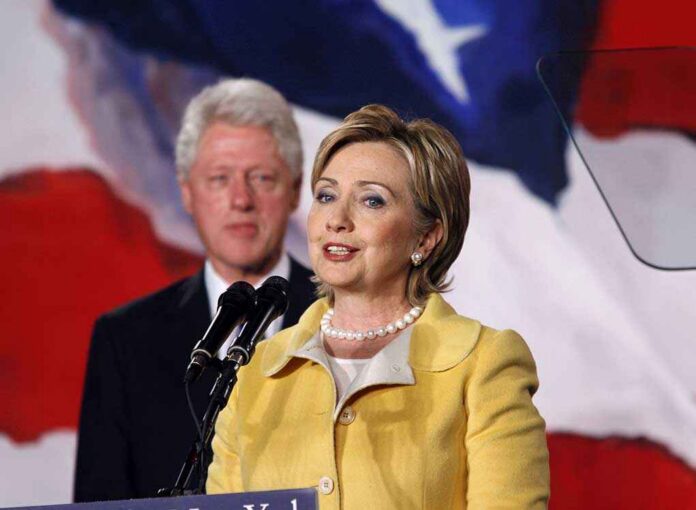
Hillary Clinton just took the “women’s rights” banner to a global stage—and handed the microphone to a transgender member of Congress, reigniting a cultural fight many Americans thought common sense should have settled.
Quick Take
- A Munich Security Conference panel on “girls’ fundamental rights” featured Hillary Clinton moderating and Rep. Sarah McBride as a key speaker.
- Neutral reporting describes McBride as a “gender rights champion,” while conservative coverage argues the framing undermines sex-based protections.
- The event happened during U.S. political turmoil tied to a partial government shutdown that reportedly canceled official congressional travel.
- Panel discussion focused on global “pushback” against women’s and girls’ rights, including exits from international agreements and organized advocacy networks.
What Happened at Munich—and Why It Set Off a Firestorm
Hillary Clinton moderated a Munich Security Conference session titled “Girls Just Want to Have Fundamental Rights: Fighting the Global Pushback” on February 14, 2026. Rep. Sarah McBride (D-DE), described in multiple reports as the first openly transgender member of Congress, appeared as a featured participant. Video from the event shows Clinton introducing McBride positively and framing the discussion around coordinated threats to rights. The format and venue gave the panel international visibility and instant political blowback.
Reporting on McBride’s attendance also intersected with Washington dysfunction at home. McBride’s office confirmed the trip, while accounts noted official congressional travel was affected by a partial government shutdown connected to Department of Homeland Security funding negotiations. That detail matters because it shows the appearance was not merely a routine congressional delegation stop. Even so, the available sources do not provide a full breakdown of who funded travel or the precise logistics beyond the confirmation.
Two Competing Narratives: “Rights Champion” vs. “Women’s Rights” Redefinition
The dispute is less about whether the panel happened and more about what it represented. Straight-news coverage presented the session as part of an effort to counter global rollbacks on women’s and girls’ protections, and it characterized McBride as a “gender rights champion” facing organized opposition. Conservative commentary, by contrast, portrayed Clinton’s choice of guest as a symbol of modern progressive politics prioritizing gender ideology over sex-based categories—an argument that continues to drive state and federal battles over language and policy.
The sources show clear evidence of the rhetorical collision, but limited evidence of measurable policy outcomes from the panel itself. No documented resolutions, formal commitments, or follow-up announcements are included in the provided research. What is verifiable is the contrast in framing: one side positions the event as solidarity against global repression; the other sees it as a public example of redefining “women” in a way that many conservatives argue creates legal and cultural confusion, especially around sex-specific rights and safeguards.
What McBride Advocates in Congress—and Why It Matters Politically
McBride’s congressional agenda is a key reason the appearance resonated beyond a single conference panel. The research notes McBride has co-sponsored legislation tied to reproductive policy and data privacy, including the Women’s Health Protection Act, the Access to Reproductive Care for Service Members Act, and the My Body, My Data Act. Those priorities align with a broader progressive platform that treats abortion access and related policy as central rights issues, helping explain why global forums place such figures in “rights” conversations.
Global Rights Talk Meets American Culture-War Reality
Panelists discussed international “pushback,” including countries leaving the Istanbul Convention and the role of organized networks pushing legal and cultural shifts. Another participant cited in the research, Open Society Foundations president Binaifer Nowrojee, tied rollbacks in women’s protections to broader conflict and accountability themes. Those claims are presented as part of the panel’s perspective; the research does not include counterarguments from conference organizers or critics in the room. What is clear is that the panel blended security-conference prestige with culture-war flashpoints.
The Bottom Line for U.S. Politics Under Trump in 2026
For conservative voters already frustrated by years of top-down cultural messaging, this episode illustrates how elite international settings can amplify the same debates playing out at home—often without the practical guardrails Americans expect, like clear definitions in law and policy. The available reporting confirms the event’s facts and the sharply different portrayals, but it does not confirm broader claims that the panel directly changed policy. It did, however, hand both sides fresh footage and talking points in an already heated national argument.
OUTRAGE! Hillary Clinton Hosts Panel on “Fundamental Rights For Women” – and Her First Guest is a Man Pretending to be a Woman: Trans Rep. “Sarah” McBride (VIDEO) https://t.co/vn2iSYd7nn
— The Gateway Pundit (@gatewaypundit) February 14, 2026
With Trump back in the White House, the political question is less about Clinton’s legacy brand and more about where institutions draw lines going forward: between sex-based protections, speech expectations, and the expanding reach of ideological definitions into public life. The research shows the panel’s theme centered on “fundamental rights,” but the controversy shows how quickly that phrase can become contested when Americans disagree on the basic terms—especially when “women’s rights” and “gender rights” are treated as interchangeable in high-profile venues.
Sources:
transgender-lawmaker-sarah-mcbride-hillary-clinton-girls-rights-forum
delaware-sarah-mcbride-dnc-congress-election-2024
congress-first-transgender-mcbride
hillary-clinton-hosts-panel-fundamental-rights-women-her