
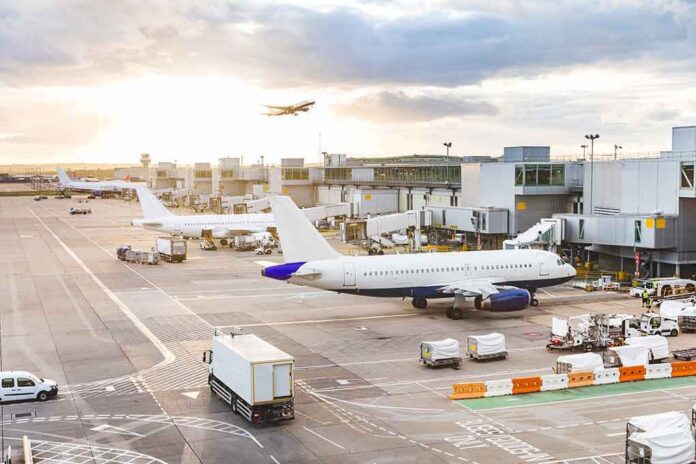
Controllers told the UPS crew to yield, yet the Copa jet’s wingtip still met the UPS jet’s nose on a Miami taxiway.
Story Snapshot
- Federal Aviation Administration said controllers instructed the UPS crew to give way to the Copa aircraft.
- The Copa Boeing 737’s wingtip struck the UPS Boeing 767’s nose while both taxied at Miami International Airport.
- Radio audio captures “Somebody hit us,” and a UPS pilot saying, “Yeah, we went too far”.
- The contact happened about 9:15 p.m. at a taxiway intersection; two injuries were reported by some outlets.
What Happened On The Ground At Miami
Federal Aviation Administration officials said controllers told the UPS crew to yield to the Copa aircraft before the collision. The aircraft then made contact while taxiing, not on a runway. The Copa Boeing 737’s wingtip struck the nose of a UPS Boeing 767 cargo jet, a geometry that matches a jet edged too far into a conflict zone. The exchange on the radio summed it up in plain words: “Somebody hit us,” followed by the UPS crew, “Yeah, we went too far”.
Miami International Airport’s communications chief said the incident occurred at about 9:15 p.m. at the intersection of two taxiways, an exactable point on the airport map. That detail matters. Investigators can align taxiway geometry, camera footage, and controller logs to replay the scene. Reports differed on injuries, with some noting none and others saying two people were hurt, a common swing in the first hours after an event.
The Stakes For Surface Safety
Taxiways are highways without guardrails. There is no shoulder to save a bad turn. The Department of Transportation’s runway incursion work catalogs thousands of surface conflicts, including hundreds on taxiways alone, proving this is a known class of risk, not a fluke. Federal aviation safety material shows that most incursions trace back to human factors on the flight deck, even when controller direction is clear. Workload, task saturation, and misjudged distances can pile up fast.
Regulators have warned that surface events grow from many small roots. The Federal Aviation Administration’s safety alerts describe how complex layouts, radio traffic, and momentary loss of awareness create the perfect setup for a wrong stop line or an overrun by a few feet. That is all it takes for a wingtip to meet a nose at taxi speed. Recent safety reviews also show that pilot deviations make up the largest share of incursions, even at major airports with advanced systems.
What The Early Record Shows So Far
The record now shows four key points that align. Controllers told the UPS crew to give way to the Copa jet, placing right-of-way on the table. The physical contact involved the Copa wingtip and the UPS nose, which fits a nose past the hold point. The radio captured the Copa pilot’s immediate report and the UPS pilot’s admission of taxiing too far. The time and the intersection are fixed, which allows precise reconstruction with airport systems and logs.
🚨 BREAKING: TWO INJURED AFTER UPS CARGO PLANE COLLIDES WITH COPA AIRLINES JET AT MIAMI AIRPORT
A UPS Boeing 767 cargo plane and a Copa Airlines Boeing 737 passenger jet collided on a taxiway at Miami International Airport on Saturday night.
🔹 The Copa jet's wingtip struck the…
— Fact Checker (@FactCheckero1) November 15, 2026
Investigators will still collect the full audio, readbacks, and surface radar to lock down sequence and spacing. That is standard, and it should be. But the public facts already anchor a clear narrative spine. From a common-sense, conservative view, rules and right-of-way exist to keep order. When a controller says “give way,” the safe action is to stop short and hold that line. The surface system only works when every crew treats that line as a hard wall.
Why This Matters Beyond One Night In Miami
Air travel depends on quiet victories that never make the news. Most happen on the ground. The lesson here is not panic, but discipline. America’s aviation edge rests on checklists followed, clear radio calls heard and read back, and firm respect for markings in paint and light. Data show we still see over a thousand surface incursions a year, with pilot actions leading a majority of cases. That is solvable with sharper training, simpler layouts, and zero slack at the hold line.
Sources:
mediaite.com, abcnews.com, cnn.com, cbsnews.com, en.cibercuba.com, endtimeheadlines.org, aol.co.uk
© conservativehub.com 2026. All rights reserved.