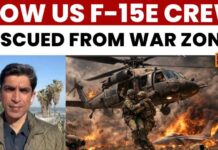
In modern war, the most valuable “weapon” might be the story told over a smoking crater.
Story Snapshot
- An F-15E Strike Eagle went down over Iran, triggering a high-risk U.S. combat search-and-rescue mission in hostile airspace.
- Iranian-linked outlets flooded the internet with wreckage photos and sweeping claims of multiple U.S. aircraft destroyed.
- U.S. reporting confirmed one crew member rescued and described damage to rescue aircraft, while the second crew member’s status remained uncertain in early updates.
- The images may show U.S. forces destroying equipment to prevent capture, a common practice that can look like “Iran shot it down.”
The shootdown that turned into a messaging war
An American F-15E Strike Eagle reportedly fell out of the sky over central Iran on a Friday morning, and the real fight immediately moved from radar screens to newsfeeds. Iran’s narrative raced ahead: state-linked media claimed Iranian air defenses downed the jet and then mauled the rescue attempt. U.S. accounts, citing officials, focused on the mission’s purpose—get aircrew out—while acknowledging the rescue package took hits.
The F-15E detail matters because propaganda often lives in the blurry space between aircraft silhouettes. Iranian reports initially described an F-35, a single-seat stealth jet that carries a huge psychological punch. Later reporting pointed to a twin-seat F-15E, a workhorse strike fighter with a pilot and a weapons systems officer. Two ejections create two human stakes, and that split instantly becomes leverage for whoever can claim custody, recovery, or defeat.
Combat search-and-rescue is built for heroics and heartbreak
Combat search-and-rescue, or CSAR, is the military equivalent of running into a burning house while someone shoots at the firefighters. Reports described Black Hawk helicopters and C-130 variants supporting the effort, with fixed-wing cover including an A-10. This isn’t window dressing; CSAR packages layer communications, refueling, escort, and medical capability because every minute on the ground invites enemy forces, local militia, and bad luck.
Early U.S. reporting said one F-15E crew member made it out alive, rescued by special operations personnel, while the search continued for the second. Iranian claims escalated dramatically, asserting multiple U.S. aircraft losses—transports and helicopters included. The split between “we lost some gear” and “they lost everything” is where experienced readers should slow down, because rescue missions often include deliberate destruction of disabled aircraft to keep secrets out of enemy hands.
Why wreckage photos don’t settle what actually happened
Iran circulated images of charred metal said to be American: tail fins, wings, and ejection-seat components. Analysts who live in the details look for identifiers—shapes, fasteners, structural patterns—that match a specific airframe. The War Zone’s assessment captured the responsible middle ground: some imagery appeared consistent with an F-15E, but the fog of war leaves room for misdirection, recycling, or manipulation.
Wreckage can be truthful and still misleading. A helicopter that limps home after taking fire may later get written off, stripped for parts, or destroyed in place if it can’t be recovered. To a camera lens, “hit during rescue and scuttled” and “shot down in flames” can look identical. Iran understands that Americans argue in public about numbers, and adversaries exploit that reflex by dropping selective visuals that force U.S. spokesmen into careful, often unsatisfying language.
The political value of a pilot, and the conservative lesson about leverage
The human piece drives the urgency. A downed American aviator is not just a life at risk; it’s a potential bargaining chip and a propaganda trophy. President Trump publicly referenced continuous monitoring of the second crew member, described as a colonel, signaling the White House saw the strategic danger in leaving ambiguity to fester. Americans should recognize the common-sense truth: hostile regimes don’t “hold” people for humanitarian reasons.
From a conservative, America-first lens, the priority stack is clear. Recover the crew. Deny the enemy intelligence windfalls. Don’t let an adversary define victory by posting photos first. The uncomfortable part is that operational secrecy—necessary in a live rescue—often collides with the public’s demand for instant clarity. Iran weaponizes that gap, portraying normal U.S. silence as proof of disaster. The best counter is competence, not theatrics.
What this incident signals about escalation, deterrence, and hard choices
Reports tied the incident to a broader period of U.S.-Iran tension and talk of strikes, with Iran claiming “new” air defense deployments in the region. That context matters: even older systems can be deadly when layered with radars, missiles, and small-arms fire against low-flying helicopters. If an A-10 truly took damage and its pilot ejected and was rescued, that underscores how quickly a recovery mission can expand into a larger combat event.
The open loop is the second F-15E crew member. Until confirmed recovery or confirmed capture emerges, every side benefits from selective ambiguity. Iran can hint at triumph, while the U.S. can avoid telegraphing tactics and locations. For readers, the takeaway isn’t to choose a team’s headline; it’s to watch what each side claims and what it can actually prove. In the age of viral wreckage, strategy often rides on narrative discipline.
Sources:
Photos Of F-15E Wreckage Emerge Amid Iranian Claims It Shot Down An American Fighter
American fighter jet F-15E downed over Iran