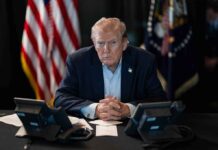

Three senior Secret Service communications officials, including the agency’s communications chief, were escorted out and had their clearances pulled amid an inquiry tied to sensitive presidential security details.
Story Snapshot
- Three Secret Service communications staffers placed on leave and stripped of access.
- The Office of Professional Responsibility is running the internal probe, with potential criminal angles reported.
- Reports link the matter to disclosures about President Trump’s covert Turkey-to-Britain plane swap.
- FBI and Central Intelligence Agency roles were reported, signaling a serious breach concern.
What Happened Inside the Secret Service
The Secret Service removed three communications-office employees from headquarters and put them on administrative leave. Outlets named the communications chief, Anthony Guglielmi, among those sidelined. Reporters described them as “do not admit,” and said their security clearances were suspended. The agency confirmed three non-law-enforcement personnel were placed on leave for potential misconduct under review by the Office of Professional Responsibility, which handles internal standards and discipline.
Coverage cited sources who said the Federal Bureau of Investigation and the Central Intelligence Agency were involved. That level of outside interest suggests concerns beyond routine personnel policy. While the Secret Service’s public line is an administrative review, press accounts described a potential criminal inquiry. That dual track appears in other national security leak probes, which often start with access limits and expand as facts firm up.
The Sensitive Event at the Center
Reporters tied the personnel actions to disclosures around President Trump’s covert aircraft swap after a reported Iranian threat. The Washington Post detailed how Air Force One served as a decoy while the president moved by an alternate military aircraft from Turkey to Britain. The account included logistics worthy of a screenplay, down to concealment methods used on the tarmac to avoid detection by watchful eyes.
Trump later said the Secret Service and the military wanted him on a different plane because of a threat. That aligns with the idea that any related operational details would be tightly held and time-sensitive. Even if some intelligence officials later voiced doubts about the threat’s credibility, the Service still moved to protect the president. In that world, even a fragment of real-time movement data can put a target at risk.
Why This Probe Looks Different
The removal of a communications chief is rare. Communications offices handle public messages, press logistics, and sensitive timing. That team sits near operational facts about routes, wheels-up windows, and decoy tactics. If the reported FBI and Central Intelligence Agency participation proves accurate, investigators may be mapping whether a disclosure cut across both criminal leak laws and counterintelligence concerns. That is a sharper posture than a typical workplace-policy review.
Recent history shows how these cases often unfold. Agencies suspend access, isolate systems, and freeze the risk. They then run parallel tracks: an internal standards probe to secure evidence, and, if needed, a referral to criminal investigators. Reuters described a similar rhythm during a 2025 Pentagon leak inquiry, where multiple officials were placed on leave as the scope widened. The logic is simple: first stop the bleeding, then trace the source.
What Matters for Protection and Accountability
Protective security runs on silence and timing. The power is in denying an adversary even a hint of “where, when, and how.” That is why conservatives and common-sense readers alike expect zero tolerance for operational leaks that could endanger a president or vice president. If the facts show someone compromised movement data or decoy details, discipline should be swift and public. If not, clear exoneration should follow, with access restored just as visibly as it was removed.
The Road Ahead
The Office of Professional Responsibility will collect devices, emails, and logs. Investigators will test who saw what, when, and why those facts appeared in press accounts. The best signal to watch is whether the case moves from administrative to prosecutorial hands. Another signal is whether the agency releases a formal justification for the clearance actions once the case closes. That transparency helps defend good officers and deters the next would-be leaker.
Sources:
thegatewaypundit.com, yahoo.com, washingtonpost.com, newsbreak.com, bbc.com, nytimes.com, democracynow.org, apnews.com, cnn.com, aa.com.tr
© conservativehub.com 2026. All rights reserved.