
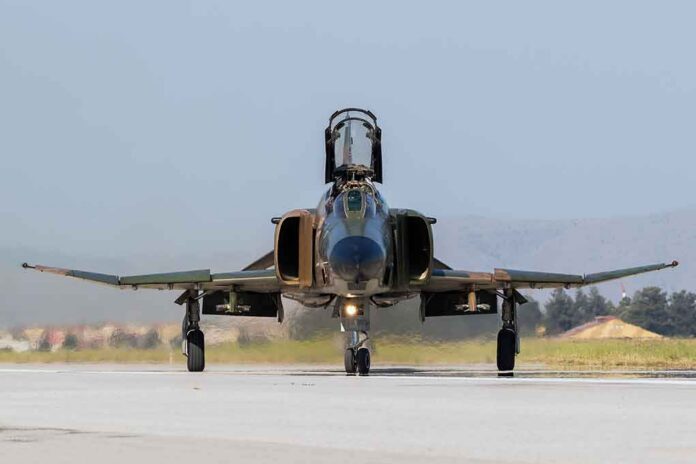
The Texas Air National Guard pilot punched out, lived, and kept everyone on the ground safe.
Story Snapshot
- A Texas Air National Guard F-16 crashed during a routine training flight in Michigan
- The pilot ejected, survived, and received hospital care in stable condition
- No other injuries were reported by Michigan State Police
- Officials ordered a one-mile evacuation around the crash site amid hazmat concerns
What Happened And Where Responders Drew The Line
Texas Military Department officials said a 149th Fighter Wing F-16 Fighting Falcon went down during a routine training mission from the Combat Readiness Training Center in Alpena on Thursday afternoon. The jet crashed in Grand Traverse County near Green Lake Township shortly before 2 p.m., drawing fire, police, and medical units to the scene. Michigan State Police reported no other injuries. Authorities set a one-mile evacuation zone due to a hazardous chemical risk cited after the crash.
The pilot ejected, survived, and received treatment at a nearby hospital, according to Texas Military Department statements also echoed by multiple outlets. Local officials described the response timeline beginning at 1:52 p.m., with crews securing the area and checking for secondary hazards. Early reports named Green Lake Township; some coverage referenced nearby townships and crossroads, a common variance when scenes span rural lines during fast-moving events.
Why A One-Mile Bubble Made Sense
Crash sites can release fuel, hydraulic fluids, and pyrotechnic devices used in seats and canopies. Michigan State Police said the one-mile evacuation followed a hazardous spill risk linked to the crash, a standard move to keep residents clear while teams assess fumes, fire, or debris. That stance tracks with the playbook for downed high-performance jets: lock down the perimeter, test the air, cool hot spots, and only then scale back the cordon as readings allow.
In plain terms, responders bought time and space to avoid turning one mishap into many. The record shows no civilian injuries, which suggests that fast decisions and clear lines worked. This is the quiet success in many military aviation incidents. A jet can fail. A response plan should not. Officials will count that as a win: the pilot lived, first responders were protected, and the public went home.
What We Know Versus What Comes Later
Officials confirmed the aircraft type, the Texas unit, the routine training profile, the pilot’s survival, and the lack of reported civilian injuries. The cause was not released. That delay is normal. The Air Force runs formal safety and legal investigations that secure evidence and reconstruct events before blaming a system, a bird, a checklist, or a bad decision. Those boards exist to prevent repeat failures and to ground any discipline or claims in facts, not hunches.
F-16 crash details in Michigan: toxic exposure, possible bird strike https://t.co/PzPzEF49ay
— The Detroit News (@detroitnews) September 18, 2026
Context helps. Fighter mishaps are rare in rate terms but not unheard of given high-tempo training. Past reports have traced F-16 crashes to engine faults, maintenance errors, or control issues, each with its own fix once proven. That history is why investigators pull maintenance logs, flight data, and wreckage forensics before they speak. The process is slow by design, but it is how the service learns and keeps crews and communities safer on the next sortie.
Safety, Duty, And The Public Interest
The facts line up with a disciplined chain: pilot ejects, crews secure, police inform, and commanders commit to find cause and prevent the next one. That is the compact Americans expect from military units training near homes, schools, and farms. Common sense and conservative values say do the job, protect the innocent, and own the outcome. Here, the community stayed safe, the pilot survived, and the system moved to learn. That is the right order of priorities.
Sources:
feedpress.me, abcnews.com, chron.com, cbsnews.com, stripes.com, thehill.com, youtube.com, safety.af.mil, afjag.af.mil
© conservativehub.com 2026. All rights reserved.