
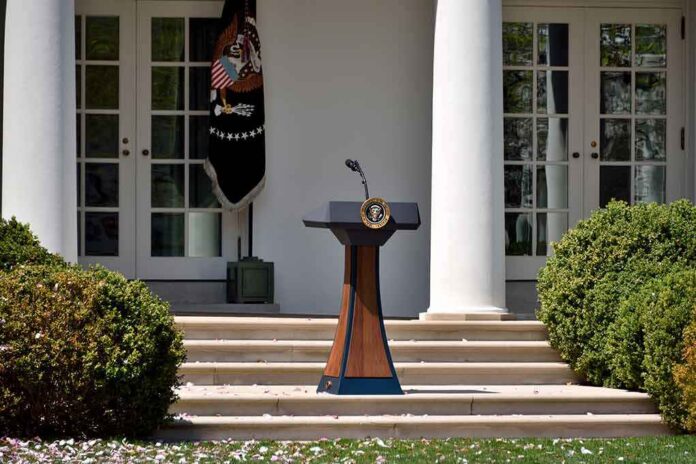
Cameras caught President Trump with his eyes closed and head drooping during a live Oval Office event, and the White House is now arguing over whether that counts as sleep.
Quick Take
- Video from a June 4, 2026 Oval Office coal-industry announcement shows Trump with his eyes closed and nodding, while Energy Secretary Chris Wright was speaking.
- The White House Rapid Response account denied Trump was asleep, insisting his eyes were open in the clip that circulated online.
- A separate fact-check from Lead Stories found the footage does not prove Trump lost consciousness, noting he reopened his eyes within seconds.
- Secretary of State Marco Rubio told Congress he has never seen Trump fall asleep, then was shown video appearing to contradict that claim.
- The episode joins a string of similar clips from Cabinet meetings and other public events, feeding a larger debate about Trump’s age and alertness.
What The Oval Office Video Actually Shows
The footage comes from a public event on June 4, 2026, where Trump sat through a coal-industry announcement alongside Energy Secretary Chris Wright. A fact-check from Snopes, updated the following day, confirmed the video is authentic and shows Trump closing his eyes and nodding off more than once during the appearance. The clip was not leaked or anonymous. It was recorded in the open, on camera, for anyone to review.
A seven-second excerpt is what spread fastest online, and that short version is doing a lot of the arguing. Lead Stories, a separate fact-checking outlet, reviewed the longer recording and reported that Trump briefly closed his eyes before reopening them about four seconds into the clip. That distinction matters. A blink or a momentary head dip looks different from a full doze once you see the whole sequence instead of a chopped-up snippet built for outrage.
The White House Pushes Back Hard
The administration did not stay quiet. The White House Rapid Response account fired back at the account that posted the clip, writing bluntly that Trump’s eyes were “literally open” in the footage being shared. White House spokesperson Davis Ingle went further, calling Trump “the sharpest, most accessible, and energetic president in American history,” and another spokesperson dismissed the entire allegation as a “baseless conspiracy theory”.
That kind of forceful denial is standard politics, but it does not erase what the camera recorded. The White House is arguing interpretation, not disputing that the video exists or that Trump’s eyes appear closed at points. Even its own rebuttal implicitly concedes there is footage worth explaining. The real fight here is over what closed eyes mean, not whether they were closed.
Rubio’s Denial Meets A Video Problem
Secretary of State Marco Rubio added fuel when he told lawmakers, “I’ve never seen him fall asleep,” and insisted Trump’s late-night phone calls prove the opposite problem, that he barely sleeps at all. Representative Ted Lieu then played video from a December 2, 2025 Cabinet meeting appearing to show Trump struggling to keep his eyes open while Rubio himself was talking. The contradiction is hard to miss. Rubio’s blanket denial does not hold up well next to footage from a room he was standing in.
This is not the first time similar clips have surfaced. Reports describe comparable moments during wartime remarks and other Cabinet sessions, building a pattern critics point to again and again. Each new clip triggers the same cycle: footage spreads, the White House calls it dishonest or out of context, and a fact-checker weighs in somewhere in between. Nobody disputes the pictures. They dispute what the pictures prove.
Why This Keeps Happening And What It Really Tells Us
Short video clips make for powerful political ammunition because they feel like proof, even when they capture only a sliver of a longer moment. Researchers who study visual misinformation have found that authentic, unedited footage can still create a misleading impression simply by stripping away context. That is exactly the tension playing out here. Nobody claims the Oval Office video was faked. The argument is entirely about what a few seconds of closed eyes actually mean for a 79-year-old president running the country.
Voters do not need a forensic video lab to have an opinion on this. They can watch the clips themselves and judge whether a president nodding off during official business, however briefly, is a fair question to ask. The White House wants this treated as a smear. The footage, circulated again and again from separate events, makes it a legitimate thing for Americans to keep watching closely.
Sources:
mediaite.com, lieu.house.gov, soapcentral.com, atlantablackstar.com, thedailybeast.com, snopes.com, inquisitr.com, aol.com
© conservativehub.com 2026. All rights reserved.