
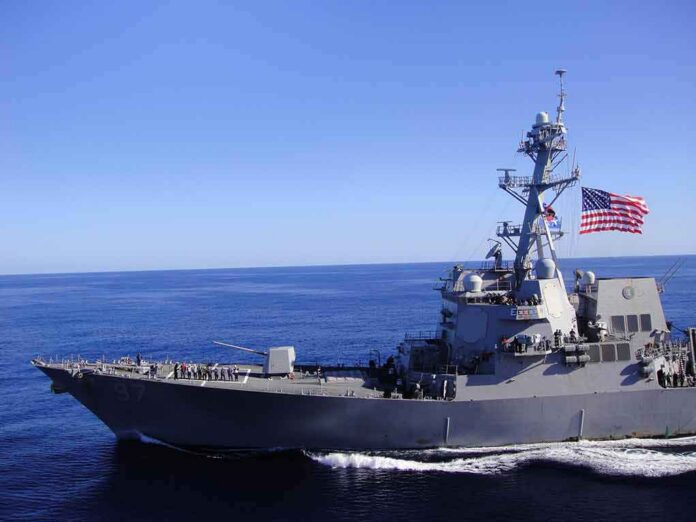
Iran is lining up tankers while President Trump signals he is ready to sink any escort that tests the U.S. blockade.
Story Snapshot
- A formal advisory documents the blockade order, scope, and enforcement timeline.
- Trump warns Iranian warships will be “at the bottom of the sea” if they challenge it.
- Reports say visible Iranian crude exports have plunged in recent months.
- Iran signals convoy plans and vows to use “all available means” in response.
The Blockade Exists On Paper And At Sea
The United Kingdom Maritime Trade Operations Joint Maritime Information Center advisory lays down the facts. It cites a July 13 presidential announcement of a U.S. naval blockade against Iran and U.S. Central Command enforcement starting July 14 at 2000 Zulu. It defines the blockaded area as Iran’s whole coastline, including ports and oil terminals. That is the operational map ships see, not rumor. This document sets timing, geography, and intent in black and white.
Public messaging from Washington matches the advisory’s hard edge. President Trump told Fox News he hopes Iran tries to run the blockade and said Iranian warships would end up “at the bottom of the sea.” The language leaves little doubt about deterrence goals. Supporters will call it clarity. Critics will call it risky. Either way, the signal is simple: do not test the line with naval escorts or armed “fishing” boats near tankers.
Pressure Shows Up Where It Hurts: Oil Flows And Revenue
Reuters reports a sequence that matters for leverage. The United States imposed the blockade April 13, lifted it in June after a draft understanding, and restored it July 14 when talks collapsed. The same reporting says visible Iranian crude exports have fallen to near zero in recent months. That drop helps the administration argue the blockade bites, even if other tools like sanctions and insurance limits also weigh on exports. Cause and effect overlap in this space.
Iran’s moves suggest it takes the blockade seriously. Regional reports describe more than a dozen tankers positioned near Kharg Island, with crews aboard and flags raised. The implied plan is a convoy toward the Sea of Oman. That picture signals Tehran treats this as more than rhetoric. The record, however, does not show a convoy actually sailing or crossing the blockade line yet. Preparation is pressure. Passage would be escalation.
Tehran’s Words Promise Friction; Its Decision Will Decide Risk
Iran’s Foreign Ministry calls the blockade military aggression and says Iran will use all available means to confront it. Officials also cite a right of self-defense under the United Nations Charter. Those claims set a legal and political frame for any future move. They also keep domestic pressure high to act. Words can move markets, but ships move reality. Until a convoy sails, the standoff hinges on intent and restraint on both sides.
Iranian media and lawmakers add heat. A semi-official outlet floated a 14-tanker convoy idea and a lawmaker suggested military escorts. Another warning threatened retaliation against Gulf energy sites if tankers are hit. These claims push a narrative that raises the stakes for any clash in the Strait of Hormuz. They also try to raise the insurance cost and strategic risk for U.S. partners if a shot gets fired.
Law, Scope, And Common Sense Questions Still Need Answers
The advisory states the blockade applies to all vessel traffic, regardless of flag. Other reporting frames it as targeting ships entering or leaving Iranian ports, not neutral ships transiting the Strait of Hormuz to other destinations. That mismatch invites confusion at sea, which is dangerous in a narrow waterway with fast boats, drones, and jittery crews. Clear, public guidance to shippers would reduce the risk of a tragic misread.
The legal basis also needs daylight. The advisory documents the order, scope, and start, but not the underlying legal theory or any congressional or United Nations authorization. The administration can strengthen its hand by releasing the directive and legal memo that define authority and rules of engagement. Sunlight here serves deterrence and aligns with common sense: clear red lines, clear rules, fewer accidents. That is how you keep pressure without stumbling into war.
What To Watch Next: Convoys, Contacts, And Commerce
Three signals will tell the next chapter. First, whether Iranian tankers actually depart en masse with escorts. Second, how the U.S. Navy and coalition ships handle first contact inside the stated zone, including warnings, redirection, or disabling actions short of sinking. Third, whether oil shipments and prices react more to a visible convoy than to talk. Strong navies deter by posture and procedure. Wise states back steel with paperwork that everyone can read.
Sources:
townhall.com, en.royanews.tv, sacbee.com, en.ilsole24ore.com, yahoo.com, fr.jpost.com, vinnews.com
© conservativehub.com 2026. All rights reserved.