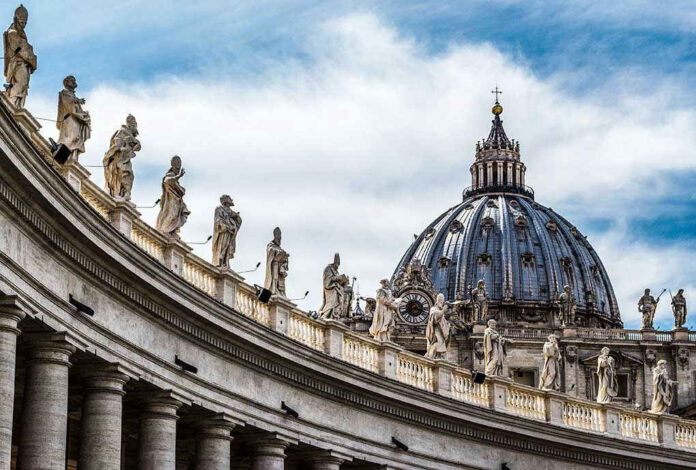
A sacred altar in Vatican City was brazenly desecrated during Holy Mass, exposing the disturbing erosion of respect for tradition and order at revered institutions worldwide.
Story Snapshot
- A man urinated on the Altar of Confession at St. Peter’s Basilica during public Mass, shocking hundreds of worshippers.
- The act follows a troubling pattern of recent desecrations at one of Catholicism’s holiest sites.
- Vatican authorities have not released an official statement; the perpetrator’s identity and motives remain undisclosed.
- The incident spotlights concerns over declining reverence, lax security, and broader cultural disrespect for sacred places and values.
Desecration at the Heart of Catholicism: What Happened
On Friday, October 10, 2025, during the 9 a.m. Holy Mass at St. Peter’s Basilica in Vatican City, a man climbed onto the Altar of Confession—one of Catholicism’s most sacred sites—and urinated on it in front of a stunned congregation of worshippers and tourists. Security officers responded quickly, removing the man from the basilica, but the event left an indelible mark on those present and reverberated across Catholic and secular communities alike. Despite the incident’s gravity and the circulation of video footage, Vatican officials have remained silent, offering no clarity on the perpetrator’s identity or punishment.
Reports indicate this was not an isolated event. The Altar of Confession, situated above the tomb of St. Peter and reserved for the most solemn liturgies—including those led by the Pope—has suffered multiple acts of vandalism in recent years. In February 2025, another individual disrupted Mass by climbing the altar and throwing candelabras to the ground. In June 2023, a protester stripped and displayed political messages on the same site. These repeated intrusions raise urgent questions about both security protocols and the broader societal decline in respect for religious and cultural heritage.
Security Failures and Erosion of Tradition
The basilica’s open access during religious services, a longstanding gesture of welcome to pilgrims and tourists, has become a double-edged sword. While millions visit St. Peter’s annually, increased foot traffic post-pandemic has heightened the challenge of maintaining order and reverence. Security is typically visible, but the frequency and audacity of these desecrations suggest significant gaps remain. The absence of any official Vatican response as of October 12 further fuels concerns over institutional accountability and the willingness to defend tradition against rising threats—whether from protest, mental health crises, or ideological hostility to faith and family values.
Many conservative observers argue that such acts are symptomatic of a broader cultural malaise, in which respect for sacred spaces, moral order, and the foundations of Western civilization are routinely undermined by permissiveness and political correctness. The repeated targeting of Christian sites, especially during the tenure of past left-leaning governments, has been met with muted outrage from global elites while everyday citizens, particularly those of faith, are left to wrestle with the consequences. This incident is seen as a wake-up call to restore not only security but also a culture of respect for what is sacred and enduring.
Societal Implications and the Call for Accountability
The short-term impact has been shock and outrage among Catholics and the wider public, and a swift reassessment of Vatican security. However, the long-term effects could be more profound. If such incidents continue unchecked, they threaten to erode public confidence in the ability of institutions to protect core values and heritage. There is a growing call for stronger safeguards and renewed vigilance, not only in Vatican City but across Western society, where family, faith, and tradition are increasingly under assault from radical agendas and government overreach.
While some commentators point to mental health or protest motives, many in the conservative community regard these explanations as insufficient. They argue that the failure to hold perpetrators accountable and the reluctance to address ideological hostility foster an environment where such acts become more frequent. The silence from the Vatican, in this context, is seen as emblematic of a broader unwillingness among global institutions to confront the decline of traditional values head-on.
The Road Ahead: Defending Faith and Heritage
As the investigation continues and the basilica remains open under heightened security, the incident stands as a stark reminder of the urgent need to defend religious freedom, cultural heritage, and common sense morality. Conservatives and traditionalists urge leaders—both religious and secular—to take decisive action to prevent further attacks, reinforce the sanctity of cherished spaces, and restore respect for the principles that built Western civilization. The desecration at St. Peter’s is not just a Vatican issue; it is a warning of what happens when society abandons its foundational values and allows disorder to reign in the name of tolerance or political expediency.
Sources:
Man desecrates altar of St. Peter’s Basilica – Catholic World Report
Man pees on St. Peter’s Basilica Altar of Confession – Brut Media
St. Peter’s Basilica altar desecration 2025 – EWTN Vatican