

conservativehub.com — A federal judge just turned one of the loudest election fights in America into a slow-burning legal thriller about who really runs our democracy.
Story Snapshot
- A Trump-appointed judge refused, for now, to stop the mail-in voting executive order from moving forward.
- The order pushes federal agencies to help decide who is “eligible” for mail voting, raising serious state-vs-federal power questions.
- Democrats lost the first round not on principle, but on timing: the judge said their case was premature.
- The ruling keeps the door wide open for a much bigger showdown once the order is actually put into effect.
The Executive Order That Quietly Rewired a Corner of Election Law
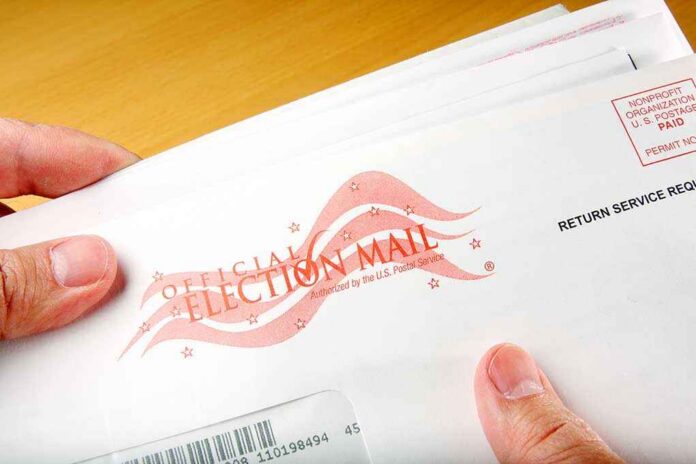
President Donald Trump’s executive order on mail-in voting does not shout with dramatic language, but its core move is aggressive: it directs federal agencies, including the Department of Homeland Security, to assemble lists of eligible voters in every state and instructs the Postal Service to make sure only those people receive mail ballots. That sounds administrative and boring—until you remember that the Constitution gives primary control of elections to the states, not Washington.
Supporters call it a basic election-integrity measure, framed by the White House itself as “ensuring citizenship verification and integrity in federal elections.” They argue that asking the federal government to verify who is actually eligible to vote by mail is common sense in an era of bloated voter rolls and razor-thin margins. That argument resonates with Americans who think secure elections require government to verify identity and citizenship, not simply trust every address label and signature.
Why Voting-Rights Groups Rushed to Court
Voting-rights organizations saw something very different. A coalition went to federal court arguing that Trump’s order was unlawful interference in elections, because the president does not have constitutional authority to regulate how states run voting. Groups like the Brennan Center warned that charging the Postal Service with deciding who may vote by mail could lead to eligible voters being denied ballots based on federal data errors or political pressure.
The challengers painted a picture conservatives should also find disturbing: a future Democratic president using the same theory to micromanage state election procedures from Washington. Their central claim is not that election integrity is bad, but that the Constitution assigns these nuts-and-bolts questions to state governments and, in some areas, to Congress—not to a single president armed with an executive pen.
The Judge Says: Not So Fast, Come Back Later
United States District Judge Carl Nichols, a Trump appointee in Washington, D.C., refused to issue an immediate injunction blocking the order.[1][2] He did not declare Trump right, and he did not declare the voting-rights groups wrong. Instead, he said the fight arrived too early. The key agencies, including the Postal Service and the Department of Homeland Security, had not yet implemented concrete rules to carry out the order.[1][2]
Without those rules in place, the judge concluded that the plaintiffs’ alleged injuries were speculative. Courts describe that problem as “ripeness”: you do not get federal judges to stop a policy based on fears about what might happen before any real-world change occurs.[2] Nichols left the door wide open for a renewed lawsuit once the administration issues specific regulations that can be measured, tested, and challenged.[1][2]
What the Ruling Really Means for Trump, Democrats, and Voters
The immediate political spin was predictable. Trump allies blasted out headlines about a “big win” and a “major victory for election integrity,” pointing to the fact that the executive order remains in force.[1] They are not wrong to say Trump cleared a procedural hurdle. The administration now has running room to build the voter-eligibility lists and design Postal Service screening rules the order envisions, at least until a court tells them otherwise.[1][2]
BIG WIN FOR PRESIDENT TRUMP & ELECTION INTEGRITY!
Federal judge UPHHELD the President’s Executive Order — MAIL-IN VOTING STANDS exactly as signed!
Rule of Law upheld .@TheDemocrats are scrambling back to the drawing board trying to figure out how to get around it.
Securing… pic.twitter.com/PVYuJbk97g
— Erica 🇺🇸🇺🇸🇺🇸 (@EricaRN4USA) May 29, 2026
Yet legal conservatives should be cautious about celebrating too loudly. The judge’s analysis focuses on timing, not ultimate legality. Once agencies start generating eligibility lists and using them to limit who receives mail ballots, any botched data or inconsistent standards will give challengers concrete examples of voters harmed by federal overreach.[1][2] At that point, courts will face the real question: did the president cross the constitutional line and usurp state authority to run elections?
The Deeper Conservative Question: Where Should Election Power Live?
This case forces a serious, non-slogan question: if you believe in federalism, how far should a president go in “helping” states run elections? The conservative instinct values both election security and limited centralized power. Robust citizenship verification and accurate voter rolls matter. But so does the basic constitutional structure that keeps Washington from dictating every detail of state election machinery.
The Trump order walks a narrow line between cooperation and control. If federal agencies merely share accurate information with states that remain free to accept or reject it, that approach aligns more easily with common-sense federalism. If, instead, federal lists gradually become de facto gatekeepers for who may vote by mail, then the same tools cheered today could be turned against conservatives tomorrow by a different administration.
Sources:
[1] Web – Judge Declines To Block Trump’s Order On Mail-In Voting
[2] YouTube – Judge won’t block judge’s mail in voting order
© conservativehub.com 2026. All rights reserved.