

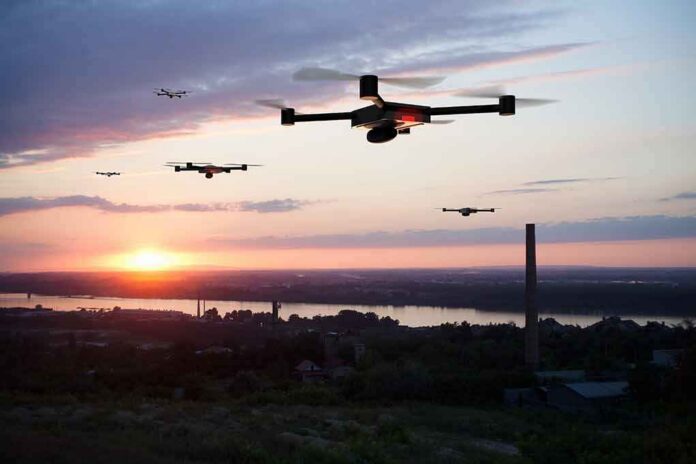
Beijing has drawn a hard line: the entire city is now controlled airspace, and private drones cannot be flown, owned, stored, or brought inside its borders.
Story Snapshot
- Revised municipal regulation took effect November 15, 2026, across all of Beijing.
- Rules ban flight, possession, storage, and transport of drones and core parts into the city.
- Authorities can confiscate drones and issue fines to violators.
- The move follows a deadly June crash near Beijing’s tallest tower, which killed the pilot.
Beijing codifies a citywide ban with teeth
The Standing Committee of the Beijing Municipal People’s Congress adopted revised unmanned aircraft rules that treat every inch of Beijing as controlled airspace. The regulation forbids drone flight, ownership, storage, and entry into the city with a drone or its core components. The city set a clear effective date of November 15, 2026. The municipal summary frames the policy as a security measure to harden the capital and unify enforcement inside one geographic shield.
The text bars residents and visitors from carrying drones into Beijing by air, rail, or road. It closes loopholes that hobbyists often use, like “just storing” a drone without flying it. The policy’s language reaches across urban districts and rural edges, a rare sweep for a single city. That scope simplifies the rule for officers in the field. If you are in Beijing, you cannot have a drone. No gray zones. No neighborhood carve-outs.
From sales curbs to full possession ban
Officials moved in steps before the wall came down. The city restricted drone sales in May 2026. The November rules then finished the job by banning possession and storage anywhere in the municipality. That progression mirrors the way regulators often tighten control when technology adoption outpaces safety tools. The Associated Press reports that noncompliant drones can be seized and that fines can hit both individuals and companies, making the ban enforceable rather than symbolic.
Authorities also gave owners a path to comply. Residents were told to remove drones from the city by the effective date, using civil aviation, rail, or road transport. That instruction matters for travelers and businesses who need a paper trail to show good-faith efforts. It also reduces the risk of sudden mass confiscations at stations or checkpoints. Clear direction, plus a deadline, usually yields fewer ugly scenes and fewer claims of selective enforcement.
Trigger event: a deadly crash, then a clampdown
A late-June crash near China Zun, Beijing’s tallest building, killed the pilot and injured 13 people. The timing lines up with the city’s rapid regulatory ratchet that followed. The incident raised the stakes around low-altitude safety in dense urban cores. While reports do not show a drone caused the crash, policymakers often answer big, visible tragedies with broad controls to avoid another headline nobody wants to read.
That instinct fits a larger governance arc. Research on China’s low-altitude economy describes rapid growth, overlapping rules, and gaps in unified airspace management. When the map is messy, local authorities sometimes choose the simplest guardrail: say “no” everywhere until a stronger system exists. The national update to the Civil Aviation Law and related analysis also flag the need for clearer classifications and accountability in the low sky where drones operate.
Security logic versus innovation goals
The ban clashes with China’s push to grow drone services, deliveries, and other low-altitude businesses. A citywide freeze on private drones in the capital sends a strong signal: when safety and control collide with hobby or commercial convenience, safety and control win. That aligns with common sense and with conservative values that put order and risk reduction first near critical government sites, financial hubs, and dense crowds. A capital city is not the place for trial-and-error airspace.
#Drone ownership ban comes into force in #Beijing over security concerns https://t.co/jJMHyaBQZB
— Ahram Online (@ahramonline) November 15, 2026
The real test will be execution. Citywide bans are clean on paper but complex on the street. Officers must spot noncompliance without turning train stations into gear checkpoints. Travelers must know the rule before they pack. Businesses must decide where fleets can live, train, and launch. If Beijing pairs the ban with well-publicized guidance, consistent enforcement, and clear routes for authorized uses, it can lock down risk without needless friction.
What matters next for residents and visitors
Owners should move drones and core parts outside Beijing and keep receipts from transport. Visitors should not bring drones into the city at all. Content creators need alternative plans, like ground rigs or permitted shoots outside the municipality. Companies should review contracts, insurance, and storage sites to avoid breach or loss from confiscation. Expect officers to focus on hubs where drones usually surface: airports, rail stations, shipping depots, and storage lockers near event venues.
Sources:
insiderpaper.com, nst.com.my, apnews.com, economictimes.indiatimes.com, rutlandherald.com
© conservativehub.com 2026. All rights reserved.