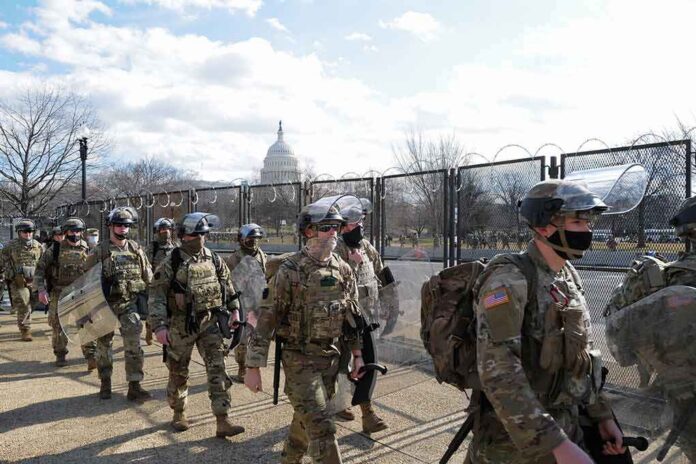
A 22-year-old Oklahoma National Guard specialist on a crime-fighting deployment in Washington, D.C., was arrested after a traffic stop revealed a handgun and no local carry license.
Story Snapshot
- U.S. Park Police stopped a vehicle for an expired tag and saw an empty holster.
- Officers found a pistol and arrested the Guard member for no D.C. carry permit.
- The case highlights D.C.’s strict, different gun rules that trap out-of-state drivers.
- Similar Guard arrests have occurred during the D.C. deployment tempo this year.
What Happened During The Traffic Stop
U.S. Park Police pulled over a vehicle in Washington, D.C., for an expired registration tag. Officers reported seeing an empty holster inside the car. That visual cue led to questions and a search that produced a handgun. Police arrested the passenger, Oklahoma National Guard Specialist Jakob Noonan, on a charge of carrying a pistol without a license under District of Columbia law. The stop and arrest occurred during his deployment in the nation’s capital as part of a crime-fighting mission.
Associated Press reporting states that court records did not show a valid District of Columbia concealed-carry license for Noonan. That is the central element of the charge. The Park Police account ties the sequence to routine traffic enforcement: expired tag, visible holster, discovery of a firearm, then the arrest. The case sits in local court, where standard criminal procedure will follow. An arrest is not a conviction, and the accused is entitled to defend against the charge.
Why D.C. Gun Rules Trip Up Outsiders
District of Columbia gun law differs from many states. The city requires a District-issued concealed-carry license and registration for handguns. Drivers cannot carry a loaded firearm in a vehicle without a D.C. permit. Even license holders must present the license and registration, disclose the gun, and follow strict location bans. Oklahoma’s rules are looser, which fuels wrong assumptions when people cross into the District of Columbia with a firearm in a car. One set of habits meets another set of laws, and the law wins.
Public safety debates often miss a simple point: the map matters. Gun owners who travel must adapt to the strictest local law they enter, not the most permissive they left. District of Columbia policy aims to reduce risk in dense, high-profile areas with heavy federal activity. Critics argue these rules ensnare the well-intentioned. Supporters argue clarity and consistency protect the public. Both can be true, but the statute still controls the roadside outcome. On carry law, ignorance is costly, and intent is rarely a defense.
The Bigger Pattern Around The Guard In D.C.
This arrest does not stand alone. The District has seen more than one firearms case linked to Guard personnel during this deployment cycle. Earlier reporting showed police arrested off-duty soldiers in two separate incidents for violating city gun laws, though prosecutors later dropped both cases. That pattern shows friction between deployment life, off-hours routines, and local criminal codes. It also shows prosecutors still exercise judgment on facts, context, and proof before trial.
National Guard soldier sent to Washington, DC, is arrested for carrying unlicensed firearm https://t.co/ECFFP9AHxJ
— つわもの (@chamono95741942) October 3, 2026
Another recent case involved a Guard member accused of drawing a gun on a fellow soldier during an argument, which underscores the strain of long missions in a city with strict rules and constant public scrutiny. These events complicate a mission already under a spotlight. Supporters of strong law-and-order deployments want clear standards and accountability. They also expect fair process. The smart take is simple: set bright lines, train to them, enforce them, and avoid turning honest mistakes into career-enders when intent and context counsel restraint.
Common-Sense Takeaways For Leaders And Troops
Commanders should brief every inbound trooper on local law before they hit the road. That means practical checklists, not slide decks. Register weapons if allowed, or store them secured and unloaded, or better yet, leave them at home when rules are tight. If a stop occurs, disclose, present documents, and comply. For a conservative reader who backs both the rule of law and those who wear the uniform, the standard is clear: respect the statute, protect the mission, and do not let a paperwork miss become a felony.
Sources:
washingtontimes.com, bostonherald.com, pressdemocrat.com, fox5dc.com, wn.com
© conservativehub.com 2026. All rights reserved.