
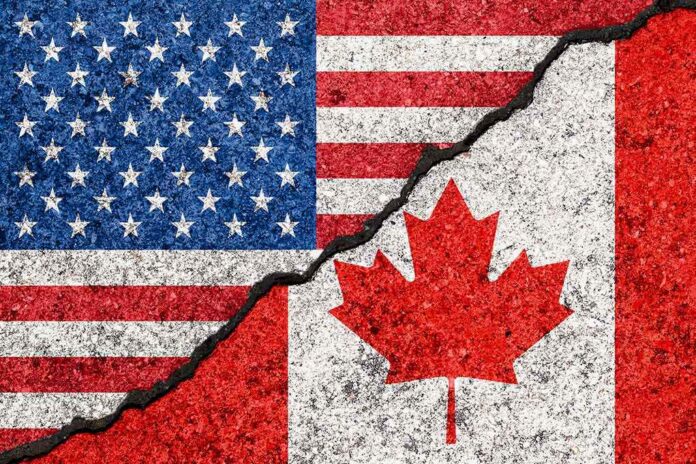
Canada’s prime minister said he prepared for the “extreme tail risk” of U.S. military action, and he framed it as simple, responsible risk management.
Story Snapshot
- Mark Carney told the New York Times he examined a very low-probability U.S. military scenario.
- He called it “not a base case” but said ignoring it would be irresponsible.
- He declined to share operational details, citing the nature of contingency work.
- Coverage links the review to Trump’s “51st state” talk and trade tensions.
Carney’s remark and what it actually means
Prime Minister Mark Carney said he prepared for the “extreme tail risk” that the United States could order military action against Canada. He gave the comment in a New York Times interview published after meetings in New York. He stressed the scenario was not the base case and was very unlikely, but said leaders must still plan for rare shocks. This is standard risk practice: low chance, high impact, do some planning. That is not a forecast; it is a duty frame.
Reporters across major outlets carried the same phrasing. They quoted Carney saying it would be irresponsible not to look at such a scenario because of its possible scale. Coverage noted that he did not provide operational specifics, which matches normal security practice. Contingency planning lives in the background. You see the headline; you do not see the binders. The essential claim stays the same: the risk was very low, and the work was contingency, not a warning of imminent conflict.
Why the idea surfaced in the first place
Stories link the planning lens to two threads. First, President Trump’s repeated “51st state” rhetoric about Canada raised eyebrows in Ottawa and beyond. Second, trade disputes and sharp talk during negotiations added heat to an already sensitive file. The combination can drive sovereignty signaling in Canada and a look under the hood at worst-case playbooks. Governments do not need probability to be high to ask “what if” when the stakes are national security.
Carney’s refusal to map out the plan’s guts tracks with how governments handle these files. Leaders acknowledge categories of risk and keep methods tight. Analysts call this prudence: a scan of the horizon, not a siren. Canada’s defense minister has also framed scenario analysis as normal business. In plain terms, adults in the room kick the tires on bad cases so the country is not flat-footed if things break bad.
How to read “extreme tail risk” without the spin
“Extreme tail risk” is a term from finance and security circles. It means a rare event with high damage if it happens. You do not bet the farm on it. You do not ignore it either. You map triggers, stress test a few responses, and move on to other files. That appears to be what happened here. The New York Times interview framed it as a risk lens, and the follow-on coverage repeated that emphasis on very low likelihood.
I TOOK ONE FUCKING DAY OFF.
ONE.
And apparently while I was gone…
🇺🇸 THE UNITED STATES STARTED INVADING CANADA. 🇨🇦
😂😂😂
WHAT THE FUCK DID YOU PEOPLE DO?
⸻
So I went looking for receipts.
Our Army says it’s unprepared for conflict.
Recruiting has been a disaster.
Our… pic.twitter.com/cGZiDDspb8— JamesSeesIt! (@JamesSeesIt) September 25, 2026
Headlines often compress this into “invasion plans,” which sounds larger than the record supports. The reporting anchors to Carney’s own words: not the base case, very unlikely, but worth a look because the costs could be enormous if lightning struck. The prudent read is that Ottawa did what allies do all the time: test assumptions, note warning signs, and tuck the memo away. That aligns with common sense and conservative principles about preparedness without panic.
What we know, what matters, and what to watch
We know Carney said he examined a U.S. military scenario as a low-probability risk and called that responsible leadership. We know he did not release details. We know multiple major outlets published the same core quotes and timing of the New York Times interview after his United Nations week in New York. We also know the spark was the mix of “51st state” talk and trade friction, which placed sovereignty back at center stage for Canadians.
Two things matter now. First, precision in language. Military “action” covers a wide range of activities and is broader than the single word “invasion.” Second, scale in response. A healthy government plans for bad days while keeping its powder dry. When the defense minister says scenario analysis is normal, that frames the work in its proper lane: background due diligence, not front-page war drums. That posture keeps allies steady and signals strength without theater.
Bottom line for readers who prefer signal over noise
Carney did not predict a war. He said he planned for a long-shot risk because that is his job. The press record supports that narrow, sober point, and ties the review to hard-edged rhetoric and trade clashes that no leader can ignore. Read the phrase “extreme tail risk” as a seat belt. You do not expect a crash on today’s drive. You still click it. That is not fear. That is adulthood in government.
Sources:
facebook.com, cbc.ca, globalnews.ca, politico.com, ctvnews.ca, foxnews.com, ndtv.com, theedgemalaysia.com
© conservativehub.com 2026. All rights reserved.