

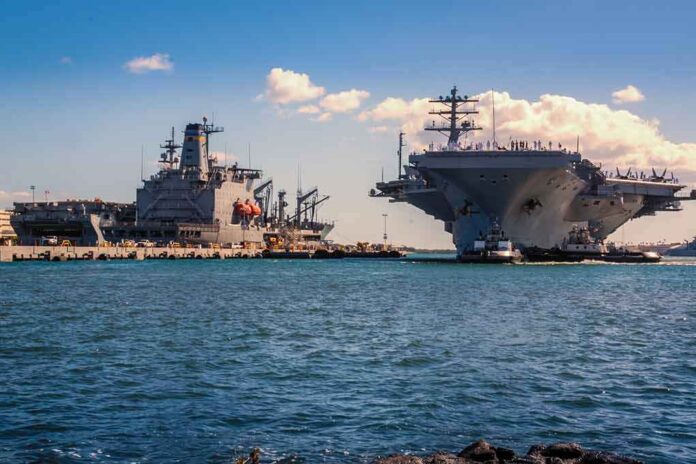
After more than 300 days at sea, a U.S. carrier came home with sky-high sortie counts and a bruising human bill.
Story Snapshot
- The Navy hailed USS Abraham Lincoln’s output: long combat time and heavy air operations.
- Officials said the carrier steamed over 85,000 nautical miles across key flashpoints.
- Congress demanded answers on crew welfare after reports of strain and supply gaps.
- The Navy acknowledged eight suicide attempts across the strike group, with no deaths.
What The Navy Says It Achieved
Acting Secretary of the Navy Hung Cao praised the mission as a clean, hard win. He said the crew “crushed their deployment,” citing 266 days deployed, 200 days in a combat zone, more than ten thousand sorties, and 1.5 million pounds of ordnance dropped. That is blunt math and big scale. It suggests a carrier and air wing that were busy almost every day. It also signals a message to rivals: the United States can surge and sustain power far from home.
A U.S. Navy official added scope and geography. The service said the ship and its escorts crossed the South China Sea, the Indian Ocean, and the North Arabian Sea, while logging more than 85,000 nautical miles. Those waters include tight straits, dense traffic, and contested zones. That kind of movement demands fuel planning, careful timing, and coordination with many partners. It also implies the crew kept tempo while shifting tasks and threats.
How The Return Was Framed At Home
The Navy said the return fit a planned rotation, not a last-minute scramble. Carrier Strike Group 3’s commander, Rear Adm. Robert Loughran Jr., and the ship’s captain, Daniel J. Keeler, were set to brief press on the pier. That detail matters. Planned rotation language signals order and readiness. Public briefings show confidence. Both seek to tell Americans this was hard, but under control. For conservatives who prize strength and clarity, that posture tracks with common sense.
Officials also leaned into crew pride. Leaders highlighted the mission name and the grit it took to execute. They pointed to aircrew flying, deck crews turning jets, and maintainers keeping systems online. They cast the ship as a tool that worked as designed. That push aims to keep focus on output and deter a rush to paint the whole tour as failure because parts of it were ugly. War is ugly. The measure is whether forces completed the mission and came back ready to fight again.
Where Critics Press For Answers
Members of Congress asked for oversight of the record-long deployment and its effects on sailors. A Senate release urged review of logistics, maintenance, and mental health support. House members asked the Department of Defense Inspector General to examine supply chains, mail problems, and access to care. These are fair questions in a republic. The public should expect a paper trail that shows why leaders extended the ship and how they balanced risk to people and platforms.
Media reports amplified families’ concerns about long stretches at sea, reduced fresh food, plumbing breakdowns, and heavy fatigue. Reuters reported that a letter from Acting Secretary Cao confirmed eight suicide attempts across the carrier strike group during the deployment, with no suicides. The Navy also acknowledged resupply limits that at times cut meal options, while stating no meals were missed. These facts do not erase the mission’s results. They do demand careful, measured fixes.
The Real Strategic Question
The bigger issue is not whether the Lincoln worked hard. It is whether the Navy planned right for demand that keeps breaking past the seven-month goal. Analysts and veterans have warned for years that carriers are running longer and harder to meet global tasks. When the schedule breaks, leaders often celebrate heroics after the fact while families tally the cost. That loop signals a force sized for peace goals, asked to meet war needs on short notice.
🔴 USS Lincoln sets Navy record: 260+ days at sea; 8 suicide attempts disclosed
The USS Abraham Lincoln carrier strike group completed a deployment of over 260 consecutive days without a port call—a Navy record—after being redirected to the Middle East following the US-Israel… pic.twitter.com/6VTCcFc4ST
— NewsTongue (@NewsTongueX) October 7, 2026
Lawmakers should get the orders, risk memos, and sustainment plans that drove this extension. If the record shows clear threats and no better option, then the hard tour was a sober choice. If the record shows hedging and delay elsewhere, then leadership needs to fix the model. Conservatives back peace through strength. Strength also means honest math. Crews can deliver 10,000 sorties once. They cannot deliver that every year without the parts, the ports, and the people to match.
Sources:
military.com, gallego.senate.gov, scottpeters.house.gov, nbcnews.com, navy.mil, reuters.com
© conservativehub.com 2026. All rights reserved.