
Wounded Americans say they opened Google to find a hospital while missiles still threatened the sky.
Story Snapshot
- Survivors say they self-triaged and used phones to find care after the Iran strike.
- A Senate letter cites troops driving themselves to a hospital and delayed evacuations.
- Pentagon officials say medical care followed standard practices and was appropriate.
- The Army completed an internal review, but families awaited a full briefing.
What survivors say happened in the golden hour
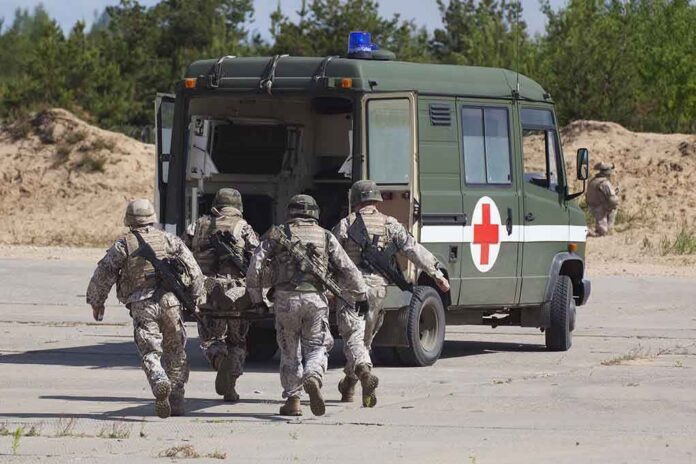
Survivors report chaos after the strike in Kuwait. They describe tying tourniquets, bracing broken limbs, and using civilian trucks and vans to move the wounded. One account says soldiers had to “Google where to find the nearest hospital,” because a clear path to care did not exist on site. CBS reporting echoes the self-triage and ad hoc transport, adding claims that a pre-strike request for more medical support went ignored. These are serious charges that demand a clean public record.
A Senate letter to the Secretary of Defense quotes survivors who climbed into vehicles and drove to a hospital in Kuwait City. It also alleges long delays in evacuating dozens of injured troops to Germany. Ten of the most serious cases reportedly moved within days, while two dozen more were flown out nine days after the blast. Delays can happen under fire, but the claims suggest planning gaps at a basic level: who calls the medevac, who stabilizes, and where the patient goes first.
What the Pentagon and Army say in response
Defense officials counter that the care met accepted standards. They say physicians evaluate all incoming patients and admit based on severity, consistent with health care practices. A Pentagon official also explained that the Germany hospital’s mission in wartime is to stabilize and then transfer patients onward, not necessarily admit them long-term. Officials have disputed reports of ignored medical staffing requests and insist the department took extraordinary steps to protect U.S. troops before and during the conflict.
The Army completed its internal review, with families expected to receive findings. Reports citing officials say no punitive action against base leadership was recommended. That aligns with a familiar pattern in military investigations: institutional learning without formal blame. Families and survivors want the full record released. Without it, the public sees clashing quotes more than verified timelines and logs.
The facts that need daylight now
Three documents could settle most doubts. First, the base’s casualty plan and staffing on the day of the strike: who the medical lead was, what equipment and vehicles were staged, and how alerts flowed. Second, the casualty timeline: timestamps for first aid, transport, arrival, imaging, surgery, and evacuation for each patient. Third, the pre-strike medical support request chain: who received it, who decided, and why. The Senate letter’s details put the burden on command to show a ready system.
Standards for mass-casualty response in the military are not guesswork. Doctrine assigns clear roles, from triage leadership to patient tracking, and stresses rehearsed links to definitive care. When troops say they searched for a hospital on a phone, that sounds like a breakdown of that chain. The Pentagon’s defense, that clinicians applied standard practice, may be true inside each clinic. It does not answer whether the system from blast site to door of the first capable hospital worked as designed.
The common-sense test for accountability
American conservative values prize duty, competence, and care for those who serve. The common-sense measure here is simple. A ready unit should not rely on Google to find a trauma bay during a war zone crisis. If pre-strike warnings asked for more medical support, leaders should either provide it or document the risk and mitigation plan. If air threat slowed evacuation, logs should show the holds and who cleared each lift. Publish the review. Show the tapes. Fix the gaps the facts reveal.
Sources:
huffpost.com, independent.co.uk, reuters.com, aa.com.tr, deseret.com, en.alwast.net, newsday.com, newsmax.com, militarytimes.com
© conservativehub.com 2026. All rights reserved.