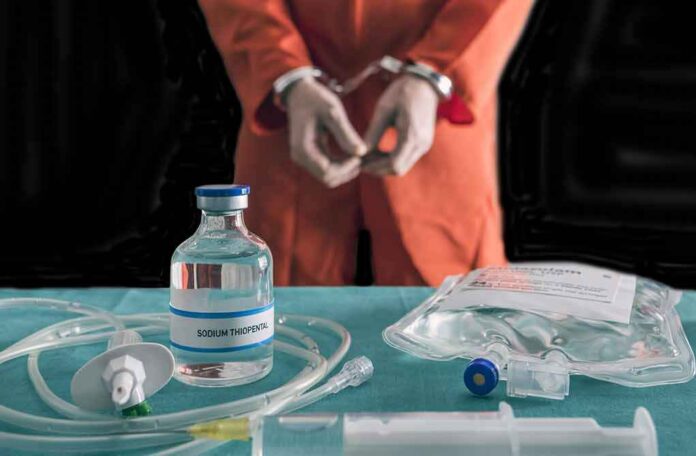
The only woman on Tennessee’s death row survived two lethal injections and then spoke from a hospital bed, turning an execution into a statewide reckoning.
Story Snapshot
- Officials confirmed Christa Pike left the death chamber alive for hospital care.
- Her lawyers say she is awake and speaking after two doses of pentobarbital failed.
- The corrections department insists it followed the state’s execution protocol.
- Her reported first words now shape the legal and moral fallout of a botched execution.
The Night Tennessee Planned a Death and Got a Crisis
Tennessee set a date, cleared legal hurdles, and prepared to carry out a lawful sentence. The state used its protocol and administered two injections that were supposed to end a life. The plan failed. The Tennessee Department of Correction said it followed every step and then confirmed Pike had been moved to an off-site medical facility for treatment. That short statement did two things at once: it admitted survival, and it framed the procedure as fully compliant with policy.
Reporters and witnesses described confusion as medical staff worked and time stretched. Officials did not give details about Pike’s condition. Her attorneys filled the gap. They said she was placed on a ventilator, later regained consciousness, and then spoke. They called the recovery “medically unprecedented” and warned her path ahead was long. The defense team’s message created a sharp image: a prisoner who heard the drugs enter her body and still lived to talk.
What Pike Said, and Why It Matters
Pike’s lawyers relayed her first words from the hospital as clear, simple human reactions to pain, fear, and survival. The exact phrasing came through them, not state doctors, because privacy laws blocked clinical updates. Her remarks did not dispute guilt or rewrite history. They did something more immediate. They turned an abstract policy debate into a vivid moment. A condemned inmate who could speak after two lethal injections forced the public to ask how this happened and what comes next.
That detail carries legal weight. Words spoken soon after a failed execution can become evidence in court filings, legislative hearings, or clemency requests. They frame the event not just as a protocol checklist but as an experience with physical and moral dimensions. When a human voice emerges from a process meant to be swift and certain, it challenges claims that the system is routine, tested, and reliable.
The State’s Position and a Narrow Lane for Accountability
The Tennessee Department of Correction stood on its protocol. It said the chemical had “consistently been effective” and that the protocol allowed no further steps beyond what staff attempted that night. That defense aligns with a conservative value set: follow the law as written, do not freelance, own the chain of command. Yet a protocol that ends with an ambulance ride invites common-sense questions. If the policy is sound, why did two doses not achieve the intended result?
This is an absolutely extraordinary failure of the execution process.
Christa Pike reportedly survived two lethal-injection attempts and is now awake and speaking. That raises serious questions about whether lethal injection is actually a reliable method of execution.
If the…
— News Forge (@NewsXForge) October 7, 2026
Reasonable conservatives expect rules to work. They also expect leaders to fix rules that fail. Pike’s survival after two injections is not a routine delay; it is a mission failure. If lawmakers intend to keep capital punishment, they must demand a process that is both lawful and competent. That means clear medical standards, transparent training, and honest after-action reviews. It also means respect for victims’ families who deserve closure delivered by a state that is precise, not sloppy.
What “Botched” Reveals About Lethal Injection
Data show lethal injection has a higher failure rate than other methods over the modern era. Analysts and legal scholars have cataloged dozens of flawed or failed attempts. Even supporters of the death penalty should see the risk of repeating preventable errors. That is not softness on crime; it is seriousness about government power. When the method fails, the state loses credibility, and the appeals never end. Pike’s case now sits in that crowded file drawer marked “fix this or reconsider it”.
The path forward is narrow. Courts will weigh filings that cite Pike’s hospital statements. The department will defend the protocol again. Lawmakers will decide whether to revise the method, improve training, or pause executions. Each choice reflects core principles: punish the guilty, protect due process, and keep the government from compounding harm. Whatever one’s view on capital punishment, a system that cannot finish what it starts erodes trust. The public expects justice that is firm, fast, and competent.
The Open Questions Still Hanging Over Nashville
What specific step failed first: the drug, the dosage, or the delivery? Who signed off on stopping after two injections, and why was that the limit? What did Pike describe about how the second dose felt, and how does that map to known drug effects? Those answers belong on sworn pages, not in rumors or leaks. Until the record is complete, Pike’s first words will echo because they came after the moment the state promised certainty and delivered doubt.
One more question sits above the rest. If the state tries again, will it repeat the same playbook and hope for a different result? Accountability means more than a review memo. It means a process that works the first time, every time—or the courage to stop and rethink the method itself. That is not leniency. That is competence and respect for the rule of law.
Sources:
© conservativehub.com 2026. All rights reserved.