
A wounded Ukrainian infantryman spent two days trapped under drones and mines until another drone lifted him out.
Story Snapshot
- Ukraine executed a battlefield rescue using a heavy-lift drone, a claimed world first.
- Ground evacuation was blocked by mines and hostile drones near the eastern front.
- Video shows the soldier harnessed to a hexacopter and flown to safety.
- Commanders say drone evacuations are a last resort but now part of war’s new reality.
The Rescue That Should Not Have Been Possible
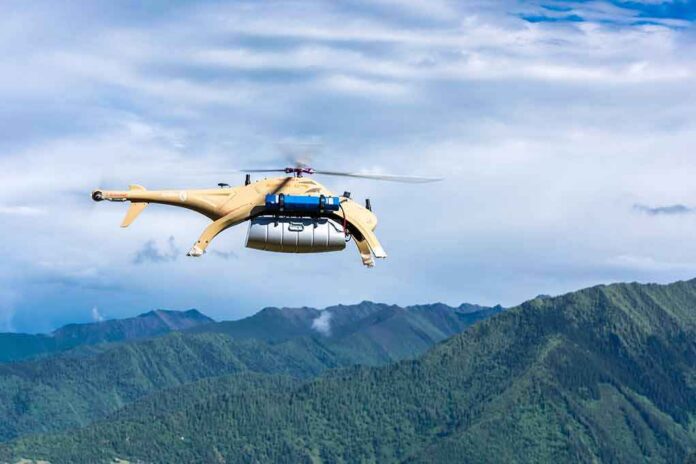
Ukraine’s 92nd Separate Assault Brigade released video of a wounded soldier strapped into a heavy hexacopter, lifting off from a kill zone and later lowering to safer ground. The unit said mines and persistent enemy drones made ground teams a target, so they turned to an unmanned aircraft built by Gurzuf Defence. The video shows the lift and the recovery phase from multiple angles, underscoring a stark fact: when roads become traps, the sky can still be a lifeline.
Reports from Ukrainian units describe the mission as the first battlefield air evacuation by a drone. Coverage notes the soldier had waited roughly two days for extraction, exposed to surveillance and attack. Rescue crews coordinated escort drones overhead to spot threats and confuse enemy operators. The hexacopter carried the casualty in a body harness, avoiding a landing in mined ground that could have set off another blast or drawn first-person-view attacks.
Why Drones Now Decide Who Lives Long Enough To Reach Care
Persistent surveillance has changed the map of survival. Medical studies say evacuation routes have moved farther back. More patients now arrive later than the old “golden hour,” because movement draws fire in a transparent battlespace. Analysts link this shift to cheap first-person-view drones, wide sensors, and fast-strike munitions that punish any vehicle or helicopter that shows itself near the front. This rescue fits that pattern: delay, danger, then a new tool that shortens the last mile.
Military planners have warned that if the skies are not safe for helicopters, units must push more care forward and improvise movement. Unmanned systems are a bridge. They move a human without risking a whole crew, trading speed and payload for survivability and cost. Experts have sketched this future for years. Ukraine just flew a version of it in combat, under fire, because nothing else could reach the casualty in time.
How The Hardware And Tactics Came Together
The hexacopter’s job was simple and brutal: lift a human mass, fly low, and land or lower safely. The team used a harness system that the casualty could secure. The aircraft likely flew nap-of-the-earth, staying below radar and frustrating enemy spotters. A swarm of smaller scouts orbited the route to watch for loitering munitions and to cue evasive moves. That layered escort, seen in descriptions of the mission, matches best practices in drone corridors now seen across the theater.
Commanders called the method a lifeline of last resort, not a routine service. That frame aligns with common sense and hard math. Heavy drones remain loud, slow, and vulnerable in wind or jamming. They cannot triage. They cannot stop bleeding mid-flight. But they can beat landmines and cut the exposure time of a stranded soldier by orders of magnitude. In a minebelt under hostile eyes, that trade is not only rational; it is moral.
What This Means For The Next Fight
This single rescue signals a shift that should push doctrine and budgets. If low-cost unmanned lifts can save lives when ground or helicopter moves are blocked, then forces will need standard kits: secure harnesses, anti-jam links, escort-drone playbooks, and landing protocols. Medical teams will need compact monitoring for drone flights and handoff drills to ground medics. The point is not flashy tech. The point is time. Shave minutes and you save limbs, then lives.
Ukraine has achieved many historic firsts in this war. Here is another one: the first-ever aerial medical evacuation of a wounded soldier using a heavy-lift drone.
On the Kupiansk front, Ukraine’s Defence Forces rescued Kostiantyn Vlasenko of the 30th Mechanized Brigade, who had… pic.twitter.com/lehLzHgfHM
— Andrii Sybiha 🇺🇦 (@andrii_sybiha) October 24, 2026
Adversaries will adapt. Expect more electronic warfare against command links, decoy beacons to lure drones, and booby-trapped extraction sites. The answer is redundancy and speed. Hardwire backup controls. Pre-map fallback landing points. Train casualties to self-attach under stress. Build drone medevac into every operation order, not as a miracle, but as a plan B ready on call. War punishes hesitation. This rescue shows how initiative, even from a buzzing machine, can beat the clock.
Sources:
independent.co.uk, aerotime.aero, yahoo.com, apnews.com, today.com, militarytimes.com, ausa.org, academic.oup.com
© conservativehub.com 2026. All rights reserved.