

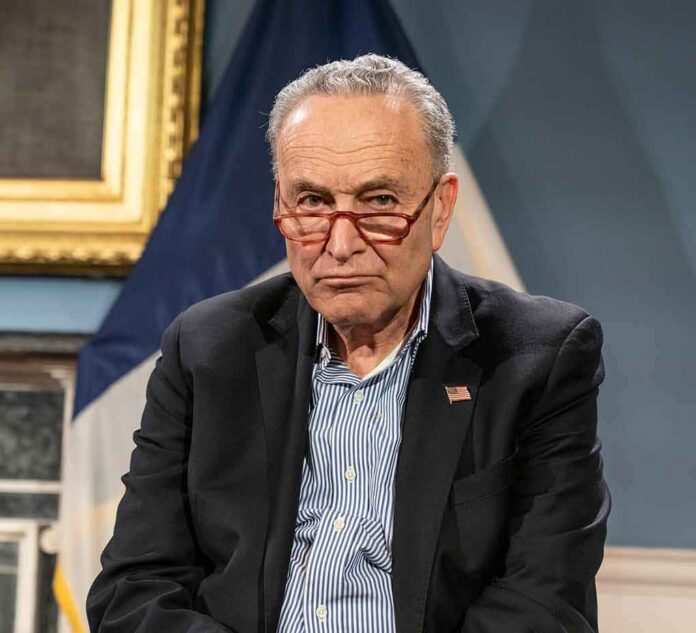
Chuck Schumer blamed Trump’s “tariff tax” for your rising bills—then dodged when pressed on Democrats’ own record.
At a Glance
- Schumer links higher prices to Trump-era tariffs, citing a $17,500 hit to new-home costs.
- Democrats pitch Affordable Care Act subsidies as a direct way to cut monthly premiums.
- Republicans counter that Democrats created the affordability crisis and blocked cost-cutting bills.
- Nonpartisan budget analysts say subsidy extensions lower premiums but raise deficits.
Schumer’s Core Charge: Tariffs And Your Wallet
Senate Democratic Leader Chuck Schumer says tariffs are not abstract. He argues they act like a sales tax on key inputs, from lumber to steel. He points to a figure now stitched into his stump speech: tariffs added $17,500 to the cost of building a typical new home. That number is meant to land with families boxed out of buying. He frames this as Trump’s “tariff tax,” and claims it ripples into rent, renovations, and starter homes alike.
Schumer pushes the point further. He says tariffs hike prices across the supply chain, then show up in grocery aisles and monthly bills. He casts Republicans as guarding those tariffs while families eat the costs. The sales pitch is simple: cut tariff pressure, cut prices. Voters do not parse trade theory. They see a payment due. He wants them to blame a clear lever they can understand—tariffs—rather than a maze of market forces.
The Health-Care Play: Extend Subsidies, Cut Premiums
Democrats also lean on health insurance math. The Affordable Care Act premium tax credits lower what eligible people pay each month. When Congress boosts or extends those credits, out-of-pocket premiums drop for families buying plans on the exchanges. The Congressional Budget Office says keeping the enhanced credits leads to lower premiums and more people insured. Let them lapse, and premiums climb while coverage falls. That is a straight line from a vote to a bill.
There is a catch, and voters deserve the full picture. The same analysts report that permanent expansion raises federal deficits. Lower monthly costs for households come with higher federal spending. That trade-off is policy, not magic. Democrats argue relief now is worth the price. Fiscal hawks argue debt today becomes higher taxes or inflation tomorrow. Both statements can be true at once. The question is which cost voters prefer to carry.
Republican Pushback: Who Really Drove Prices Higher?
Republicans fire back with a clean line: Democrats created the affordability crisis. They cite years of rising prices and accuse Schumer’s caucus of blocking reforms that would cut energy and household costs. Party spokespeople say Democrats’ spending and regulation raised the floor under prices. They pitch themselves as cutting taxes and drug prices, and putting money back in pockets. That message will sit on every gas pump and power bill this fall.
This is where the exchange turns hot. Schumer blames a “tariff tax” and promises lower premiums with bigger credits. Republicans say tariffs defend American jobs and that Democrats’ larger government footprint drives costs up. On common-sense grounds, voters can test both claims. If a policy makes a line item cheaper soon, that is real. If a plan shifts the cost to the federal tab, that cost still lands, only later. The calendar matters as much as the math.
What Holds Up Under Scrutiny
Three points clear the fog. First, Schumer did put a hard number on tariffs and homebuilding, which tees up a measurable debate over how trade policy filters into housing costs. Second, Affordable Care Act credits lower what eligible buyers pay each month; failing to extend them raises what they pay. That is not spin; it is how the formula works. Third, long-run budget impact is not a footnote; permanent subsidy expansion increases deficits by design. That trade-off is documented, not guessed.
𝟐𝟎𝟔 𝐇𝐎𝐔𝐒𝐄 𝐃𝐄𝐌𝐎𝐂𝐑𝐀𝐓𝐒 𝐕𝐎𝐓𝐄𝐃 𝐘𝐄𝐒 — 𝐒𝐂𝐇𝐔𝐌𝐄𝐑'𝐒 𝐒𝐄𝐍𝐀𝐓𝐄 𝐃𝐄𝐌𝐎𝐂𝐑𝐀𝐓𝐒 𝐁𝐋𝐎𝐂𝐊𝐄𝐃 𝐓𝐇𝐄 𝐑𝐀𝐓𝐄𝐏𝐀𝐘𝐄𝐑 𝐏𝐑𝐎𝐓𝐄𝐂𝐓𝐈𝐎𝐍 𝐀𝐂𝐓 𝐀𝐍𝐘𝐖𝐀𝐘
Republicans are forcing Senate Democrats to vote again on who pays for the power needed to… pic.twitter.com/1t1LyHJXco
— M.A. Rothman (@MichaelARothman) September 30, 2026
So did Schumer “go full ‘but Trump’ and run” when pressed on his side’s record? He stuck to tariffs and credits because those are the cleanest levers to explain. That is communications 101. But the country’s price problem never rests on one switch. Tariffs can raise input costs. Subsidies can lower premiums. Deficits can raise risk. Voters should keep all three truths in view, then ask each side to show the receipt: What gets cheaper, how soon, and who pays the balance.
Sources:
forth.news, democrats.senate.gov, washingtonexaminer.com, congress.gov, yahoo.com
© conservativehub.com 2026. All rights reserved.