

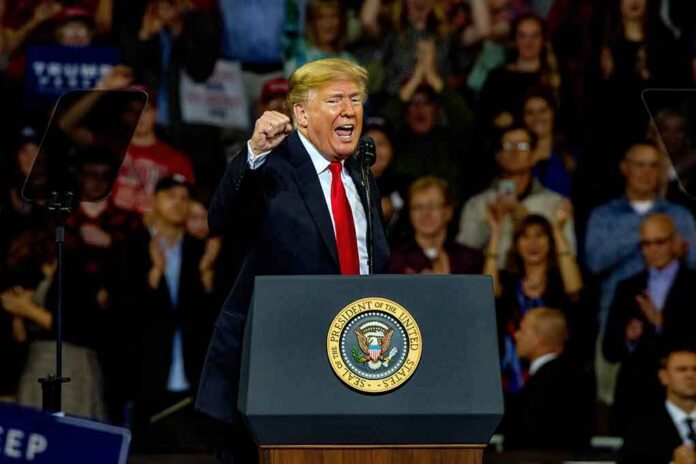
Trump told voters to treat the midterms like his name is on the ballot—and then put $5,000 on the table to prove it.
Story Snapshot
- Trump promised a $5,000 “dividend” to every adult citizen if Republicans win both chambers of Congress.
- He framed it as a reward for a strong economy and said it must be spent inside the United States.
- Vice President JD Vance said tariff revenue could fund it, but critics see a major budget gap.
- Skeptics across parties question cost, legality, and inflation risks as the debate hardens.
What Trump Said, And Why It Landed Like A Thunderclap
President Trump stood at the Republican midterm convention and made a crisp offer. If Republicans win the House and the Senate, every American adult gets $5,000. He called it the “Trump dividend” and said the cash must be spent in the United States. He linked the idea to economic strength and promised a fast reward if voters deliver Congress. Multiple outlets captured the same pledge within hours, locking the statement into the public record.
The message used plain math and simple rules. Adults only. Spend it here. No shopping trips to China or Canada with the money. That kind of clarity travels fast. It also raises sharp questions right away. Who qualifies and how is citizenship verified? How does the Treasury send it? What is the legal path? Trump did not detail funding or legal authority in the speech, which leaves process skeptics with room to push back.
How Supporters Say It Could Work
Vice President JD Vance gave the first funding sketch. He argued tariff revenue could cover the payments and called it a worker dividend. Tariffs pool cash into the Treasury every year, so the story writes itself: tax foreign goods, pay Americans. The pitch fits a populist frame that treats trade levies as a national profit share. That story aligns with a long-running conservative view that trade policy should favor domestic production and working families.
Supporters also stress the spend-in-America rule. Money that cannot be spent abroad can push demand toward local stores and factories. That could help small towns first. Many voters feel shut out of elite tax breaks and complex credits. A plain check feels fair, fast, and visible. It is politics by receipt, not by footnote. The clarity alone can rally voters who want their government to pick their side without delay.
The Hard Math, Legal Hurdles, And Inflation Fears
Cost estimates run into the trillions for a universal adult payout. Reporters noted that even optimistic tariff figures sit far below the total price of the promise. That gap fuels claims of a budget hole that would swell the deficit. Economists quoted by major outlets warn that so much cash, so fast, could spark fresh inflation or force higher interest rates. Those concerns resonate with households living through price spikes and tighter credit.
Trump redirected $176.9 million from a US human-rights fund towards global right wing groups, including $40 million for an “anti-communism” consortium and $1 million for fascist groups opposing Brazil’s Supreme Court days before the presidential election. https://t.co/NVpaAh4wjB
— Anonymous (@YourAnonCentral) October 3, 2026
Legal process adds more friction. Critics point to Congress’s power of the purse. They argue a payout this large would need legislation. They also question whether an election-conditioned transfer would stand up in court. News coverage captured this skepticism from both parties. Some Republican lawmakers said the plan looked like a risky election play that would struggle to pass. Process hawks and budget watchdogs heard alarms, not applause.
What To Watch Before November
Three gates decide the fate of the “Trump dividend.” First, the vote. The promise triggers only if Republicans win both chambers. Second, the pay-for. A formal White House plan with specific funding, timing, and eligibility would change the debate. Third, the law. A clean bill with spending authority would quiet many legal doubts. Without those three, the idea stays a rally line more than a real program, no matter how often it is repeated.
Common-sense conservatives will focus on trade-offs. If tariffs fund checks, what gives elsewhere in the budget? If the money is borrowed, what happens to rates and debt service? If the aim is to boost Main Street, can a narrower, targeted credit hit the same goal with less risk? Clarity on these questions will show whether the “dividend” is a bold reset of trade-era gains—or a costly promise that fades after the cheers.
Bottom Line: The Promise Is Clear, The Path Is Not
Trump made a direct, memorable offer, and he made it contingent on a Republican sweep. Voters heard the number, the condition, and the “spend it here” rule. Supporters can point to a simple funding story through tariffs, which matches a tough-on-trade agenda. Skeptics see legal and fiscal speed bumps that could stall the plan for months. The idea now lives where big politics always lives—between the punchy line and the fine print.
Sources:
© conservativehub.com 2026. All rights reserved.