Americans across the Middle East just got a blunt message from their embassies: have a plan to get out, because Iran’s next move could close the exits fast.
Story Snapshot
- U.S. embassies warn Americans in multiple Middle East countries to be ready to depart as tensions with Iran spike.
- Travel advisories now tell citizens to reconsider or avoid travel, with some countries at the highest danger level.
- Airports, flight routes, and even entire embassies are already disrupted by strikes and Iranian threats.
- The State Department is quietly expanding evacuations and staff drawdowns while insisting this is “precaution,” not panic.
Embassies raise the alarm and tell Americans to be ready to leave
U.S. embassies across the Middle East have pushed out unusually stark security alerts telling Americans to exercise “heightened vigilance” and to be prepared to depart if the situation escalates further. These messages stress that the security environment is “complex” and can change quickly, especially as Iran and its allied groups threaten or carry out attacks across the region. Americans are told to watch for flight cancellations, sudden airspace closures, and other disruptions that could trap them if they wait too long to move.
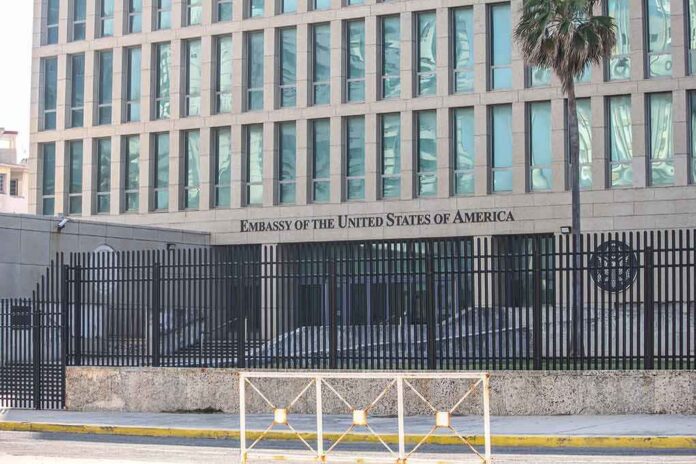
Several embassies go beyond generic caution. The U.S. embassy in Bahrain warned it has information that the Iranian regime may target unspecified locations in central Manama, and advised people to seek cover immediately if they hear explosions or sirens. Similar alerts from missions in Jordan, Oman, the United Arab Emirates and others describe Iran as “unpredictable” and warn that it may strike countries it has not targeted before. The common thread is clear: do not assume you are safe just because your host country has been quiet until now.
Travel advisories tighten as airports and routes start to shut
The State Department’s formal travel advisories now paint a clear risk map for the region. Americans are told to reconsider travel to Bahrain, Israel, Jordan, Kuwait, Oman, Qatar, Saudi Arabia, and the United Arab Emirates, which sit at Level 3 on the danger scale. Iran, Iraq, Lebanon, Syria, Gaza, and Yemen are rated Level 4, “Do Not Travel,” reflecting active conflict or very high threat levels. These ratings back up the embassy warnings and send a wider signal that normal tourism or business trips are no longer wise.
That guidance is not just theory. Many airlines have already canceled flights into and out of Middle Eastern hubs, and officials warn more cancellations are likely if Iran continues to escalate. In some places, embassies are telling Americans to shelter in place because movement itself is risky, while also urging them to be ready to leave if a window opens. For travelers who still think they can “wait it out,” this kind of rolling shutdown should be a wake-up call. Once airspace closes, you may be stuck until Washington can organize special flights.
Washington quietly expands evacuations and pulls out nonessential staff
Behind the calm language of “heightened vigilance,” the State Department is already taking concrete steps that show how seriously it views Iranian threats. After U.S. strikes on Iranian nuclear sites, officials increased emergency evacuation flights for Americans in Israel and ordered nonessential personnel and families to leave the U.S. Embassy in Lebanon. Later, the department broadened “ordered departure” instructions to cover embassies in Bahrain, Jordan, Kuwait, Lebanon, Qatar, Saudi Arabia, and the United Arab Emirates, plus consulates in parts of Turkey.
At the same time, Washington says it has assisted more than 23,000 people, either with information or seats on charter flights back to the United States. This is not the behavior of a government expecting a short-lived scare. It looks more like a long, grinding crisis where Iran and its proxies test American resolve, and the U.S. moves civilians out of the blast radius while leaving military options on the table. From a common‑sense, conservative view, this mix of evacuation and deterrence is exactly what a serious government should do when its citizens and troops are under real threat.
Worldwide warnings, fluid battlefield, and what it means for Americans
The State Department has now issued a worldwide security alert warning that Iran-linked groups may target American interests far beyond the Middle East, and urging Americans everywhere to take greater precautions. A cable obtained by reporters shows the department ordered all U.S. embassies to immediately review security and convene Emergency Action Committees because of the evolving situation and its possible spillover effects. This kind of global posture reflects a judgment that Iran’s reach is not just regional; it can touch Americans almost anywhere.
For Americans still in the region, or those with trips on the calendar, the message is not subtle. Embassies say the situation with Iran is “fluid” and warn that the regime’s recent attacks on new areas, including Egypt, show it may widen its targets without warning. They advise citizens to seriously reconsider travel through the region, to be prepared for rapid departure, and to stay in close contact with U.S. missions and the State Department’s Office of Overseas Citizens Services if they need help leaving. In plain terms, hope is not a plan. In a volatile theater where one Iranian decision can close an airport, topple a government, or hit a U.S. base, having a bag packed and a route home ready is not paranoia. It is prudence.
Sources:
mediaite.com, nytimes.com, military.com, atlanticcouncil.org, aljazeera.com, youtube.com, reuters.com, pbs.org, cnn.com
© conservativehub.com 2026. All rights reserved.